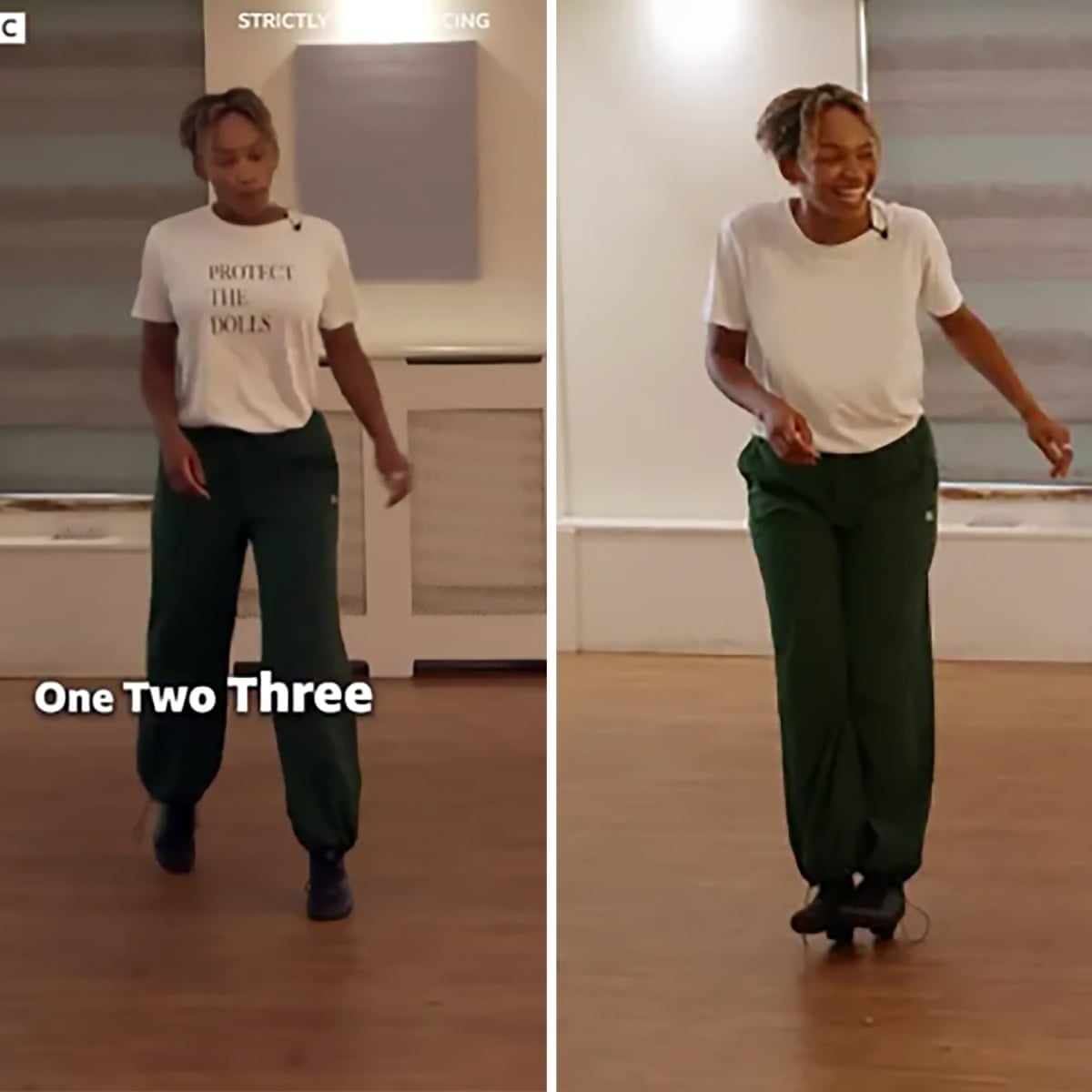
The BBC has removed the words ‘Protect The Dolls’ from a T-shirt worn by Strictly Come Dancing contestant Bethany Antonia, reigniting debate over transgender visibility and editorial impartiality on British television.
The actor, who stars in House of the Dragon, wore the slogan during rehearsals with her professional dance partner Nancy Xu. While the message was clearly visible in footage previously shared on BBC social media, it was digitally removed from the rehearsal footage broadcast on Saturday, 10 October, leaving Antonia apparently wearing a plain white shirt.
The BBC insists the decision was consistent with its editorial guidelines. But the incident has prompted a bigger question: why does a message supporting transgender women become so controversial when it appears on mainstream television?
What Happened to Bethany Antonia’s ‘Protect The Dolls’ T-Shirt?
Image from The Guardian
The slogan appeared on a white T-shirt designed by Conner Ives, whose campaign has become a recognisable expression of solidarity with transgender women.
The design has been worn by celebrities including Pedro Pascal, Tilda Swinton and Troye Sivan, with proceeds from sales supporting the UK transgender charity Not A Phase.
Antonia wore the shirt while rehearsing for Strictly Come Dancing, where she and Nancy Xu are partnered in the 2026 series. The BBC initially shared footage showing the message, but the words were subsequently removed from the version broadcast during Saturday’s programme.
The edit was also present on BBC iPlayer, according to reporting by The Guardian.
Why Did the BBC Remove ‘Protect The Dolls’?
The broadcaster defended its decision by explaining that entertainment programmes routinely take steps to minimise prominent branding and slogans, regardless of their content.
According to the BBC, the changes were made in line with its normal editorial standards rather than through a policy specifically targeting transgender rights.
There is precedent for such decisions. In 2017, the broadcaster blurred a shirt expressing support for Jeremy Corbyn, while a ‘Trans Rights Are Human Rights’ slogan worn by Kaiser Chiefs singer Ricky Wilson was reportedly obscured in certain shots of a 2024 entertainment programme.
Bethany Antonia has not publicly commented on the latest edit.
The existence of these precedents matters. It would be misleading to suggest that the BBC has confirmed a deliberate decision to suppress transgender advocacy. However, consistency in editorial policy does not remove the possibility of questioning how those policies affect LGBTQ+ visibility.
When Does Editorial Neutrality Become Invisibility?
Public service broadcasters have a responsibility to apply editorial rules fairly. That includes making decisions about clothing, branding and messaging that could be interpreted as political campaigning.
Yet there is a distinction worth exploring between explicit party-political messaging and public expressions of support for a marginalised community.
‘Protect The Dolls’ is not a party manifesto. It is a slogan associated with supporting transgender women, a group whose rights, healthcare and public visibility have become increasingly contested in British political debate.
That does not mean the BBC is obliged to broadcast every slogan. It does mean viewers are entitled to question how editorial decisions are made and whether apparently neutral rules can have unequal consequences.
After all, television does more than entertain. It also shapes which identities, relationships and experiences audiences become accustomed to seeing.
Strictly, Trans Visibility and the Bigger Picture
Strictly Come Dancing has long been part of British popular culture, bringing together audiences across generations through dance, entertainment and a considerable amount of sequins.
Its visibility also makes it an influential space for conversations about representation, even when those conversations are not part of the programme itself.
The controversy surrounding Bethany Antonia’s shirt illustrates how easily support for transgender people can become entangled with debates about political neutrality.
The BBC says it applied its usual standards. Critics of the decision may reasonably ask whether those standards need further scrutiny.
Because supporting people’s dignity should never be treated as an embarrassing wardrobe malfunction.
To provide the best experiences, we use technologies like cookies to store and/or access device information. Consenting to these technologies will allow us to process data such as browsing behavior or unique IDs on this site. Not consenting or withdrawing consent, may adversely affect certain features and functions.
Functional
Always active
The technical storage or access is strictly necessary for the legitimate purpose of enabling the use of a specific service explicitly requested by the subscriber or user, or for the sole purpose of carrying out the transmission of a communication over an electronic communications network.
Preferences
The technical storage or access is necessary for the legitimate purpose of storing preferences that are not requested by the subscriber or user.
Statistics
The technical storage or access that is used exclusively for statistical purposes.The technical storage or access that is used exclusively for anonymous statistical purposes. Without a subpoena, voluntary compliance on the part of your Internet Service Provider, or additional records from a third party, information stored or retrieved for this purpose alone cannot usually be used to identify you.
Marketing
The technical storage or access is required to create user profiles to send advertising, or to track the user on a website or across several websites for similar marketing purposes.
 Skip to content