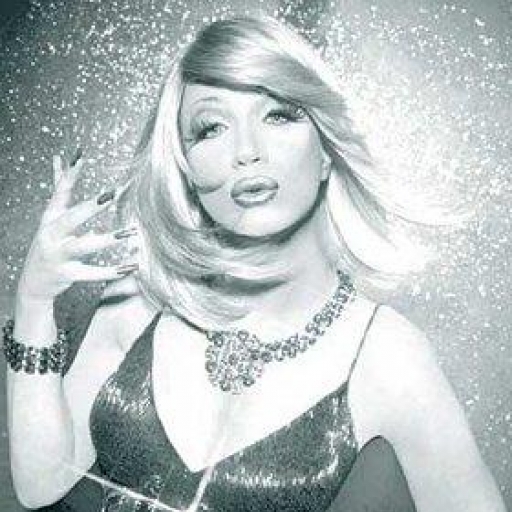
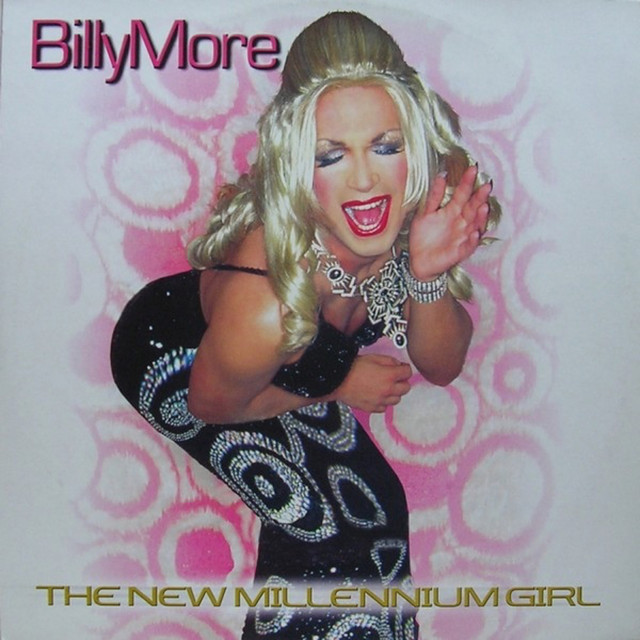
There was a moment in the summer of 2000 when Italian pop television suddenly became considerably more fabulous.
I was driving around during my holidays in Sardinia with my husband, and he started playing random music on Spotify, we left it on and all of a sudden… she started to sing one of the songs I will never forget.
Her name was Billy More. Behind the wigs, make-up, sequins and gloriously cheeky Eurodance was Massimo Brancaccio, a Milanese performer who transformed himself into a drag-pop character capable of travelling from queer nightlife to mainstream television, radio and charts across Europe.
And darling, she understood the assignment.
Up & Down (Don’t Fall in Love with Me) arrived with an irresistible beat, a knowingly suggestive title and a performer who was impossible to ignore. Billy was loud, camp, glamorous and unmistakably different from almost everything surrounding her in Italian mainstream pop.
But Billy More was more than one summer hit — and Massimo Brancaccio was much more than the man underneath the wig.
His story is also part of Italy’s queer cultural memory.
Who was Billy More — and who was Massimo Brancaccio?
Massimo Brancaccio was born in Milan on 3 February 1965. Long before Billy More became a recognisable television personality, Brancaccio had already been drawn towards performance.
In an interview later preserved by CulturaGay, he recalled dressing up and working as a club vocalist while still very young. He said he was around 19 when he began entertaining audiences during holidays on the Adriatic coast, before returning to Milan and looking for an agency that could book his performances. For years, entertainment remained something he did alongside a more conventional working life before eventually becoming his full-time career.
That detail matters because Billy More did not simply appear out of nowhere when Up & Down was released.
There was already a performer there.
Massimo understood clubs, crowds, humour and the strange little alchemy required to make people stop what they are doing and look at you.
Billy More would simply turn all of that up to eleven.
The project took shape around 2000 after Brancaccio crossed paths with DJ and producer Roberto “Roby” Santini in Milan. Santini, Alessandro Viale and Roberto Gallo Salsotto developed Up & Down, while the recorded vocals were performed by Italian-Canadian singer John Biancale. Massimo provided Billy’s body, face, attitude, comedy and stage presence; Biancale provided the voice heard on the record.
Seen through modern eyes, that actually makes Billy More more interesting rather than less.
She was a complete pop construction: part drag artist, part dance project, part visual fantasy.
Pop music has always been manufactured, darling. Billy simply had the decency not to pretend otherwise.
Up & Down went exactly where its title promised
Released in 2000, “Up & Down (Don’t Fall in Love with Me)” became the record that changed everything.
The single reached No. 5 in Italy, No. 14 in Austria and No. 21 in Germany, giving Billy a genuine international chart presence rather than merely a domestic novelty moment.
In Italy, the record exploded through dance radio. m2o’s retrospective on the track notes that it entered Radio Deejay’s Deejay Parade in June 2000 and went on to spend five weeks at No. 1 there. By the end of the summer, Billy More had reached Festivalbar, then one of the biggest fixtures in Italian mainstream music television.
And consider the company she was keeping.
The Festivalbar 2000 line-up included names such as the Backstreet Boys, Bon Jovi, Destiny’s Child, Anastacia, Enrique Iglesias, A-ha, Blink-182, The Corrs and Sinéad O’Connor.
And there, among them, was Billy More performing Up & Down.
A drag queen.
On mainstream Italian television.
In 2000.
That is worth sitting with for a second.
Because this was years before RuPaul’s Drag Race became a global franchise, decades before Drag Race Italia, and long before social media gave drag performers a direct route to millions of viewers.
Billy More did not wait for the culture to develop a comfortable vocabulary for queer representation.
She simply turned up.
In heels.
Europe noticed — especially Spain and Germany
Billy More’s reach did not stop at the Italian border.
In the CulturaGay interview, Brancaccio described Billy’s success in Spain as “colossal”, recalling television appearances in environments that also included global stars such as Ricky Martin and Jennifer Lopez. He spoke enthusiastically about Germany too, where he remembered Italian expatriate audiences supporting him during performances. Those memories are Brancaccio’s own account, but they show how quickly the project had begun travelling beyond Italy.
By March 2001, Brancaccio said he had already completed around 180 shows in Italy since April 2000, while European appearances had begun increasing.
Up & Down was also released in other European territories and Canada. ItaloDancePortal records a Canadian release as well as the record’s wider international distribution.
Billy’s later singles continued travelling.
“Come On and Do It (Saturday Night Life)” reached No. 66 in Austria and No. 82 in Germany and was released through labels in Italy, Germany, Spain and Singapore.
Other singles followed, including The New Millennium Girl, Loneliness, I Keep on Burning, Weekend, Try Me, Boom Boom!, My Rhythm of the Night and finally Gimme Love.
None reproduced the extraordinary breakthrough of Up & Down, but Billy More was certainly not a queen who appeared for one summer, collected her wig and went home.
She kept working.
She kept performing.
And she kept being visible.
Queer representation before we routinely called it representation
This is perhaps the most important part of Billy More’s story.
We should be careful not to rewrite history and turn Billy into an activist simply because we now understand her through a modern LGBTQ+ lens.
But representation does not always require a manifesto.
Sometimes representation is simply seeing somebody who breaks the rules of what mainstream culture has told you is acceptable.
For queer Italians watching television in 2000 — particularly young LGBTQ+ people far away from Milanese clubs or explicitly gay spaces — Billy More presented something unusual.
A drag performer was not being hidden away.
She was not merely the comic side character.
She was the act.
The camera was on her.
The audience knew the chorus.
The record was charting.
And everyone else simply had to deal with it.
That has power.
We now live in a media landscape where drag queens host television programmes, build enormous social followings, tour internationally and appear in advertising campaigns. It can be easy to forget how different the cultural landscape looked twenty-five years ago.
Billy’s visibility existed before much of that infrastructure did.
And she was not serving polite, watered-down queerness either.
She was properly camp.
Cheeky.
Suggestive.
Playful.
Very much in on the joke.
Very much the joke.
And very much in control of it.
Camp enough for the gays, charming enough for the grandmothers
One of Brancaccio’s most revealing observations concerned Billy’s appeal outside LGBTQ+ audiences.
In his CulturaGay interview, he argued that heterosexual audiences — including mothers and grandmothers — often loved seeing men perform in women’s clothing. He connected drag’s appeal to older traditions of theatrical cross-dressing and believed humour and avoiding crude performance helped Billy connect with audiences far beyond gay nightlife.
That insight now feels remarkably perceptive.
Billy More occupied two worlds simultaneously.
She could be visibly queer and gloriously camp while also appearing in entertainment spaces watched by families across Italy.
She did not have to stop being Billy in order to cross that boundary.
Instead, Billy made the mainstream come to her.
That is a subtle but important distinction.
Queer representation sometimes gets presented as a process of becoming sufficiently respectable for heterosexual audiences.
Billy More’s strategy seemed rather different.
Give them humour.
Give them glamour.
Give them a banging dance record.
They’ll cope.
Massimo and Billy were not the same person: and that was part of the magic
Another fascinating aspect of the project was the separation between Massimo Brancaccio and the woman audiences recognised.
Brancaccio could step out of drag and return to everyday life without necessarily being immediately identified as Billy More. The extraordinary public persona existed alongside the private man who created her.
Today, audiences familiar with drag culture understand that distinction instinctively.
There is the performer.
There is the character.
And there is the person underneath both.
In 2000, mainstream Italian audiences were effectively being introduced to that concept without necessarily having the language to explain it.
Billy More offered a fabulous little lesson in gender performance without ever turning the show into a lecture.
She simply served.
A queer figure who crossed borders
Billy’s international success also matters from an LGBTQ+ perspective.
Queer representation is often discussed within national borders: Italian queer television, British queer culture, Spanish queer nightlife.
Billy More did something slightly different.
The same visibly drag pop persona moved between Italy, Germany, Austria, Spain and other European markets, carrying that image with her.
This did not automatically mean every audience interpreted Billy politically or even explicitly through LGBTQ+ identity.
But they saw her.
That matters.
A drag queen occupying international pop spaces in the early 2000s offered queer visibility even in places where the audience may have understood her simply as outrageous entertainment.
Sometimes camp gets through doors that politics cannot.
She knew that trick before half the industry learnt the word “inclusion”.
Then, suddenly, there was no next chapter
The Billy More story becomes painfully short.
In spring 2005, Billy released “Gimme Love”, which was still receiving dance-chart attention that summer. Contemporary information from Bit Records shows the single remaining active shortly before Brancaccio’s death.
Then, on 14 August 2005, Massimo Brancaccio died in Milan.
He was just 40 years old.
Bit Records announced that Brancaccio had been “struck down by leukaemia” on 14 August, while later accounts describe the illness as acute leukaemia and report that his health had deteriorated extremely quickly.
Gay.it also reported his death at the time, remembering Billy More as a drag queen, singer and showman associated with Up & Down, Weekend and the then-recent Gimme Love.
The speed of it is difficult to comprehend.
One minute there was another Billy More record.
Then there wasn’t going to be another chapter, but girls, did she lip-sync for her legacy!
Massimo did not get to see what drag would become during the following twenty years.
He never saw RuPaul’s Drag Race grow into an international television empire.
He never saw Drag Race Italia.
He never saw Instagram turn queens into global brands from their bedrooms.
He never saw Pride marketing become mainstream, queer performers headline enormous campaigns or younger generations gain access to a vocabulary around gender expression and LGBTQ+ visibility that barely existed in mainstream Italian culture when Billy first walked onto television.
That may be the saddest part of the entire story.
Billy More had already entered spaces that would later become much more accessible to queer performers.
Massimo simply did not get enough time to see where those doors eventually led.
Why did we almost forget Billy More?
There is something strange about Billy More’s place in Italian pop memory.
Play Up & Down to people who remember the early 2000s and recognition can be almost instantaneous.
Yet Billy herself is rarely included in wider discussions about Italian queer pop history.
Part of that may be because her career was cut short.
Part may be because early-2000s Eurodance is too easily dismissed as disposable summer entertainment.
And part may simply be that popular culture is notoriously bad at preserving queer figures unless somebody consciously decides that their stories deserve preserving.
That is precisely why Billy More deserves another look.
Not because we need to pretend she changed LGBTQ+ history single-handedly.
Not because every dance single must secretly have been political resistance.
And not because nostalgia automatically makes everything important.
Billy deserves remembering because the facts themselves are remarkable.
A Milanese drag performer became the visual centre of an international dance project.
She reached European charts.
She performed at Festivalbar.
She worked mainstream television.
She crossed queer and straight audiences.
She played hundreds of shows.
And she did it while looking unmistakably, joyfully, unapologetically like Billy More.
Before Drag Race, before influencers, there was Billy
It would be far too easy to write that Billy More “paved the way” for every Italian drag queen who followed.
History rarely moves in such a tidy straight line — and queer history certainly doesn’t.
But we can say this:
Billy More was visible when visibility was harder.
She occupied pop culture before the mainstream had learnt to package queer representation into neat rainbow campaigns.
She demonstrated that audiences could embrace a drag performer without requiring her to become less camp, less suggestive or less fabulous first.
And she showed that a queer-coded character born in Milanese nightlife could travel far beyond the club.
Perhaps that is Billy More’s most important legacy.
For some people she was a dance hit.
For some she was simply hilarious, glamorous entertainment.
For others, perhaps especially queer kids watching mainstream Italian television at the turn of the millennium, she may have represented something far more intimate:
evidence that somebody different could still take centre stage.
No permission required.
No apology necessary.
Just turn the music up.
Because sometimes queer history arrives carrying banners.
Sometimes it arrives through protest.
And sometimes, babes, it arrives in a wig singing “Up & Down.”
To provide the best experiences, we use technologies like cookies to store and/or access device information. Consenting to these technologies will allow us to process data such as browsing behavior or unique IDs on this site. Not consenting or withdrawing consent, may adversely affect certain features and functions.
Functional
Always active
The technical storage or access is strictly necessary for the legitimate purpose of enabling the use of a specific service explicitly requested by the subscriber or user, or for the sole purpose of carrying out the transmission of a communication over an electronic communications network.
Preferences
The technical storage or access is necessary for the legitimate purpose of storing preferences that are not requested by the subscriber or user.
Statistics
The technical storage or access that is used exclusively for statistical purposes.The technical storage or access that is used exclusively for anonymous statistical purposes. Without a subpoena, voluntary compliance on the part of your Internet Service Provider, or additional records from a third party, information stored or retrieved for this purpose alone cannot usually be used to identify you.
Marketing
The technical storage or access is required to create user profiles to send advertising, or to track the user on a website or across several websites for similar marketing purposes.
 Skip to content