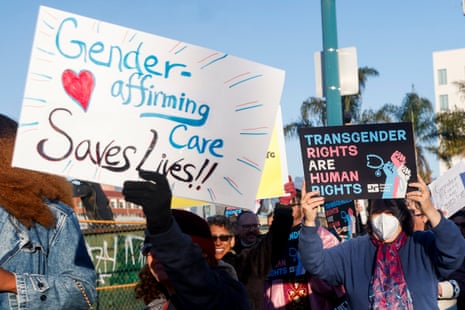
From school sports to gender-affirming healthcare, millions of Americans are preparing to vote on measures that could reshape the rights of transgender young people.
As Americans prepare for the 3 November midterm elections, the battle over transgender rights is moving beyond Congress and directly into the hands of voters. Across five states, ballot measures targeting transgender participation in school sports and access to gender-affirming healthcare will ask the public to decide questions that have become some of the most fiercely contested issues in American politics. For LGBTQ+ advocates, the votes represent far more than another chapter in the country’s culture wars. They could determine whether protections for transgender young people are preserved, restricted or made considerably harder to restore in the future.
According to Reuters, voters in Arizona, Colorado, Nebraska, Washington and Missouri will consider measures addressing transgender rights. Four states will vote on restrictions affecting participation in girls’ and women’s sports, while Colorado and Missouri will also consider measures limiting aspects of gender-affirming medical care for minors. The proposals differ in scope, but together they demonstrate how transgender rights have become a major political battleground ahead of the midterms.
School Sports Become a Political Flashpoint
In Arizona, Colorado, Nebraska and Washington, voters will decide on measures that would restrict the participation of transgender girls and women in female sporting categories. Supporters argue that sex-based eligibility rules are necessary to protect fairness and opportunities for female athletes. Opponents contend that the proposals discriminate against transgender people and could expose young athletes to additional scrutiny over their bodies and identities.
Arizona and Nebraska already have laws restricting transgender participation in female sports. However, the proposed measures would go further. In Arizona, the restrictions would be extended to private schools, alongside provisions concerning access to changing rooms and bathrooms. Nebraska’s proposal would place its existing restrictions into the state constitution, potentially making future legislative changes substantially more difficult.
Washington’s proposed rules have attracted particular concern because they would require verification of an athlete’s biological sex by a healthcare professional. Critics warn that such requirements could create intrusive procedures and additional barriers for students seeking to participate in school sport. The debate has therefore expanded beyond competitive fairness into questions of medical privacy, discrimination and the role of schools in regulating young people’s identities.
Gender-Affirming Healthcare Is Also on the Ballot
The political stakes extend beyond the playing field. Colorado voters will consider a measure prohibiting transition-related surgeries for minors, while Missouri will vote on whether to incorporate its existing restrictions on gender-affirming medical treatment for children into the state constitution.
The distinction matters. A restriction enacted through ordinary legislation can potentially be amended or repealed by a future legislature. Constitutional provisions generally require a more demanding process to change, meaning that the consequences of a successful ballot measure may continue long after the politicians campaigning for it have left office.
Medical care for transgender adolescents remains the subject of significant clinical, ethical and political debate, including disagreements over the evidence supporting particular interventions. Yet the ballot measures raise a separate question: how much authority should elected governments and voters exercise over decisions involving patients, families and medical professionals?
Why Trans Rights Have Become Central to the Midterms
Transgender rights have become an increasingly prominent feature of Republican political messaging, particularly following Donald Trump’s return to the White House. Campaigns concerning school sport, parental authority and healthcare have helped place a relatively small and frequently marginalised population at the centre of national political debate.
Supporters of the proposed restrictions present them as necessary safeguards, while LGBTQ+ organisations argue that the campaigns encourage voters to view transgender people primarily through the lens of controversy and political conflict. The result is an electoral environment in which the everyday experiences of transgender students and families can become overshadowed by competing claims about fairness, safety and individual rights.
The significance of these votes also extends beyond the United States. Debates over transgender participation in sport and access to healthcare are taking place across Europe, including in the United Kingdom, although the legal and medical frameworks differ considerably. American ballot initiatives are therefore likely to attract international attention, both as potential policy precedents and as examples of how LGBTQ+ rights can become the subject of direct electoral campaigns.
A Defining Moment for LGBTQ+ Rights
On 3 November, voters will make decisions with potentially lasting consequences for transgender young people and their families. The results will not resolve the wider debate over gender identity, healthcare or sporting eligibility, but they will determine whether several states introduce new restrictions or strengthen existing ones.
For LGBTQ+ communities, the central question is not simply which political side wins. It is what happens when the rights, privacy and opportunities of a minority become questions decided at the ballot box. The outcome will offer an important indication of where American politics, and the country’s increasingly polarised debate over transgender equality, may be heading next.
To provide the best experiences, we use technologies like cookies to store and/or access device information. Consenting to these technologies will allow us to process data such as browsing behavior or unique IDs on this site. Not consenting or withdrawing consent, may adversely affect certain features and functions.
Functional
Always active
The technical storage or access is strictly necessary for the legitimate purpose of enabling the use of a specific service explicitly requested by the subscriber or user, or for the sole purpose of carrying out the transmission of a communication over an electronic communications network.
Preferences
The technical storage or access is necessary for the legitimate purpose of storing preferences that are not requested by the subscriber or user.
Statistics
The technical storage or access that is used exclusively for statistical purposes.The technical storage or access that is used exclusively for anonymous statistical purposes. Without a subpoena, voluntary compliance on the part of your Internet Service Provider, or additional records from a third party, information stored or retrieved for this purpose alone cannot usually be used to identify you.
Marketing
The technical storage or access is required to create user profiles to send advertising, or to track the user on a website or across several websites for similar marketing purposes.
 Skip to content