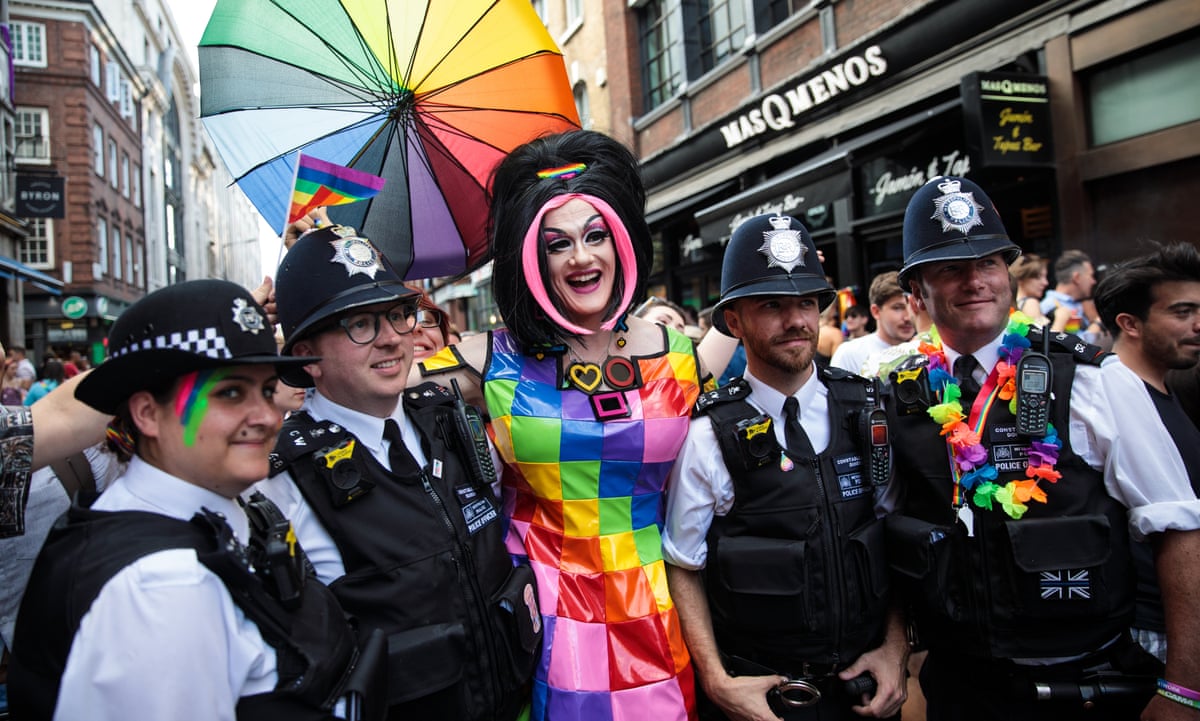
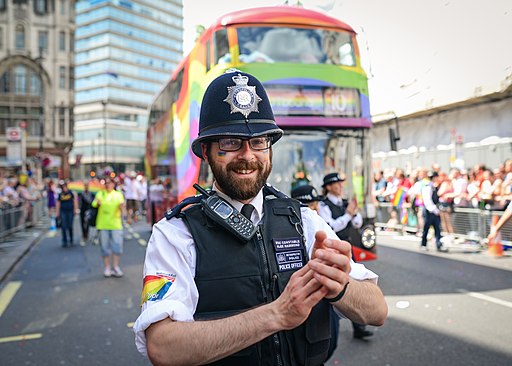
Home Secretary Shabana Mahmood has backed restrictions on uniformed police officers taking part in Pride marches. But if LGBTQ+ visibility is increasingly treated as a political statement, where does that leave equality, inclusion and the officers themselves?
Once upon a time, seeing police officers carrying rainbow flags at Pride was widely presented as evidence of progress.
For generations, LGBTQ+ communities had experienced harassment, discrimination and, in some cases, outright persecution by the very institutions expected to protect them.
The sight of uniformed officers marching alongside queer communities could therefore carry considerable symbolic weight.
But in Britain, that symbolism is now at the centre of another political controversy.
On 18 November 2026, Home Secretary Shabana Mahmood backed restrictions on police officers taking part in Pride marches in uniform, arguing that policing must remain visibly impartial.
And suddenly, the question is not simply whether police should attend Pride. It is whether their participation represents community engagement or political endorsement.
Why Is Shabana Mahmood Challenging Police Participation at Pride?
Speaking to senior policing leaders, Mahmood announced plans for a new national standard on impartiality.
The proposed guidance will be developed by the College of Policing and is expected to address officers’ participation in public events, the display of potentially political symbols and relationships with campaigning organisations.
In her official speech, Mahmood argued that law enforcement must apply the law consistently and maintain public confidence.
Her remarks followed a High Court ruling concerning Northumbria Police’s participation in Newcastle’s Northern Pride march in 2024.
The court found that the force’s approach to uniformed participation had breached its duty of impartiality.
However, there is not yet a new nationwide ban in force. The government has commissioned a standard that will be subject to consultation in early 2027.
When Does Visibility Become Political?
Supporters of tighter rules argue that police officers must avoid appearing to endorse particular political positions or campaigns.
There is a legitimate principle at stake. The police serve the entire public, including people who disagree about important social and political questions.
But critics warn that treating LGBTQ+ participation as inherently political risks sending a different message: that queer identities themselves are controversial.
Nik Adams, a senior City of London Police officer and national policing lead on LGBTQ+ matters, expressed concerns about the effect of framing LGBTQ+ issues as contested.
The distinction between supporting people’s equal treatment and endorsing a particular political programme deserves serious examination.
A rainbow flag can represent different things to different people. It may symbolise community, solidarity and equal treatment, but Pride events can also include campaigning around legislation and public policy.
Pretending these distinctions do not exist helps nobody.
Pride and the Police Have a Complicated History
There is another side to this debate that deserves attention.
Not everyone in the LGBTQ+ community welcomes police participation at Pride.
Some activists argue that Pride’s roots in resistance to criminalisation and police oppression make institutional participation uncomfortable, particularly when concerns remain about discrimination and the treatment of vulnerable groups.
In 2022, Pride in London organisers asked uniformed Metropolitan Police officers not to join the march, amid concerns about institutional homophobia.
That history complicates any suggestion that removing police uniforms from Pride automatically represents an attack on LGBTQ+ equality.
The question is not whether every uniform must be celebrated. It is whether decisions about police participation are made through fair, transparent principles rather than treating LGBTQ+ inclusion itself as suspicious.
A genuinely impartial police service must treat everyone fairly, protect peaceful demonstrations and maintain the confidence of the communities it serves.
That includes LGBTQ+ people.
The forthcoming consultation should therefore address not only uniformed participation but also how officers can engage with LGBTQ+ communities, support colleagues and demonstrate their commitment to equal protection without endorsing particular political campaigns.
Because institutional neutrality should never become an excuse for institutional indifference.
Britain does not need to choose between impartial policing and LGBTQ+ equality. It needs institutions capable of protecting both.
To provide the best experiences, we use technologies like cookies to store and/or access device information. Consenting to these technologies will allow us to process data such as browsing behavior or unique IDs on this site. Not consenting or withdrawing consent, may adversely affect certain features and functions.
Functional
Always active
The technical storage or access is strictly necessary for the legitimate purpose of enabling the use of a specific service explicitly requested by the subscriber or user, or for the sole purpose of carrying out the transmission of a communication over an electronic communications network.
Preferences
The technical storage or access is necessary for the legitimate purpose of storing preferences that are not requested by the subscriber or user.
Statistics
The technical storage or access that is used exclusively for statistical purposes.The technical storage or access that is used exclusively for anonymous statistical purposes. Without a subpoena, voluntary compliance on the part of your Internet Service Provider, or additional records from a third party, information stored or retrieved for this purpose alone cannot usually be used to identify you.
Marketing
The technical storage or access is required to create user profiles to send advertising, or to track the user on a website or across several websites for similar marketing purposes.
 Skip to content