 Skip to content


Erika Hilton has made history in Brazil’s 2026 election, winning 1,596,472 votes and becoming the most-voted woman ever elected to the country’s Chamber of Deputies.
That is not social-media hyperbole. It is an actual electoral record.
The 33-year-old PSOL politician was re-elected in São Paulo on 4 October with more than six times the number of votes she received when she first entered the federal Chamber in 2022. She finished second among candidates for federal deputy in São Paulo and third nationally, behind Nikolas Ferreira and Lucas Pavanato.
And yes, the distinction matters.
Hilton was not the most-voted parliamentarian in Brazilian history. Nikolas Ferreira received more than 3.1 million votes in 2026, while Lucas Pavanato received just over 3 million. Hilton’s record is specifically, and significantly, this: no woman has ever received more votes in an election for Brazil’s Chamber of Deputies.
For a Black trans woman in one of the largest democracies in the world, that is a political milestone worth looking at properly.
Erika Hilton’s 1.59 million votes broke a record that had stood since 2018

Before Hilton, the record for the most votes received by a female candidate for the Chamber belonged to Joice Hasselmann, who won 1,078,666 votes in São Paulo in 2018.
Hilton surpassed that figure by more than half a million votes.
The increase from her own previous result is equally striking. Hilton entered the Chamber in 2022 with around 256,000 votes. Four years later, that figure had risen to nearly 1.6 million.
That means her support did not merely grow, it multiplied by more than six.
And that changes the nature of the story.
LGBTQ+ politicians are often discussed primarily in terms of representation, who entered the room, who broke a glass ceiling, who became “the first”. Those moments matter, but Hilton’s 2026 result is also about something else: electoral weight.
Nearly 1.6 million voters did not simply witness a trans woman occupying political space. They actively chose to send her back there.
From one of Brazil’s first trans MPs to chairing the Women’s Rights Commission
Hilton was already part of Brazilian political history before this election.
In 2022, she and Duda Salabert became the first two trans women elected to Brazil’s Chamber of Deputies. Before entering Congress, Hilton had served as a councillor in São Paulo.
Then came another first.
On 11 March 2026, Hilton was elected president of the Chamber’s Commission for the Defence of Women’s Rights, becoming the first trans woman to lead the body. She received 11 votes, while ten ballots were left blank.
Her position is not merely ceremonial. The commission deals with legislation and policy involving women’s rights, discrimination, violence and gender equality.
That puts Hilton in a very different political position from the familiar idea of an LGBTQ+ politician existing mainly as a symbol of representation.
She is now participating directly in the machinery of one of Brazil’s principal legislative institutions.
Erika Hilton’s politics go well beyond LGBTQ+ rights

Reducing Hilton to “the trans politician” would also miss a large part of why her profile has expanded so dramatically.
LGBTQ+ and trans rights remain part of her legislative agenda. In February 2026 she introduced Bill 388/2026, which proposes a national TransCidadania programme focused on education, employability, professional training and financial independence for trans and travesti people facing social vulnerability. The proposal is currently moving through the Chamber’s committee system.
But perhaps the issue most closely associated with her outside LGBTQ+ politics is Brazil’s debate over the 6×1 working schedule, where employees can work six days followed by one day of rest.
Hilton is the author of PEC 8/2025, a proposed constitutional amendment that would limit the normal working week to 36 hours and establish a four-day working week, without an automatic reduction in salary. The proposal became one of the focal points of Brazil’s national debate over working hours.
That matters when trying to understand the size of her 2026 vote.
Her electorate cannot simply be read as 1.59 million people casting a symbolic vote for trans visibility. Hilton has built a political profile around labour rights, social policy, gender equality and LGBTQ+ issues.
Representation may have opened the story.
Politics made it considerably bigger.
Her historic result came during a very different national political shift
There is another part of the election that makes Hilton’s record more interesting.
Brazil did not suddenly move uniformly towards the political left in 2026.
The Liberal Party expanded its presence significantly in Congress, winning the largest representation in both the Senate and the Chamber, while Brazil’s presidential contest moved to a second round between Luiz Inácio Lula da Silva and Flávio Bolsonaro.
So Hilton’s result cannot neatly be presented as evidence that Brazil as a whole has shifted in one ideological direction.
Something more complicated happened.
The same election produced a stronger conservative presence in Congress while simultaneously giving nearly 1.6 million votes to a Black trans politician from PSOL.
Both realities can exist at once.
And perhaps that contradiction tells us more about modern Brazilian politics than any easy headline about the country becoming either more progressive or more conservative.
Why Erika Hilton’s election result matters for LGBTQ+ representation
The word “historic” gets thrown around rather freely in LGBTQ+ news.
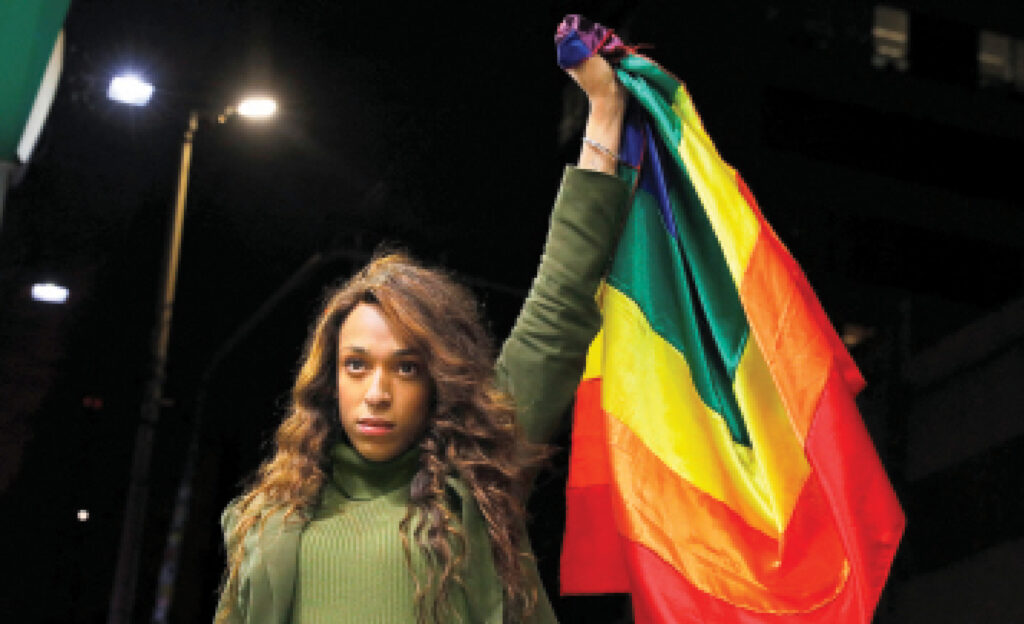
Sometimes every celebrity coming out, every election result and every rainbow-coloured corporate logo seems to earn it.
This result actually meets the definition.
Hilton did not merely win re-election.
She became the most-voted woman in the history of Brazil’s Chamber of Deputies, breaking a record set eight years earlier, and did so after already becoming one of the first trans women ever elected to the institution.
That does not mean transphobia has disappeared from Brazilian politics. It does not mean Hilton represents every trans Brazilian, and it certainly does not mean her legislative agenda will automatically succeed in a politically divided Congress.
But it does undermine one particularly persistent assumption about LGBTQ+ political representation: that visibly queer or trans politicians can succeed only within small, niche electorates.
Almost 1.6 million people just voted for Erika Hilton.
They knew she was trans.
They knew her political positions.
They knew exactly who they were voting for.
And they returned her to Congress with the highest vote ever recorded for a woman seeking a seat in Brazil’s Chamber.
That is not simply visibility.
It is political power.


