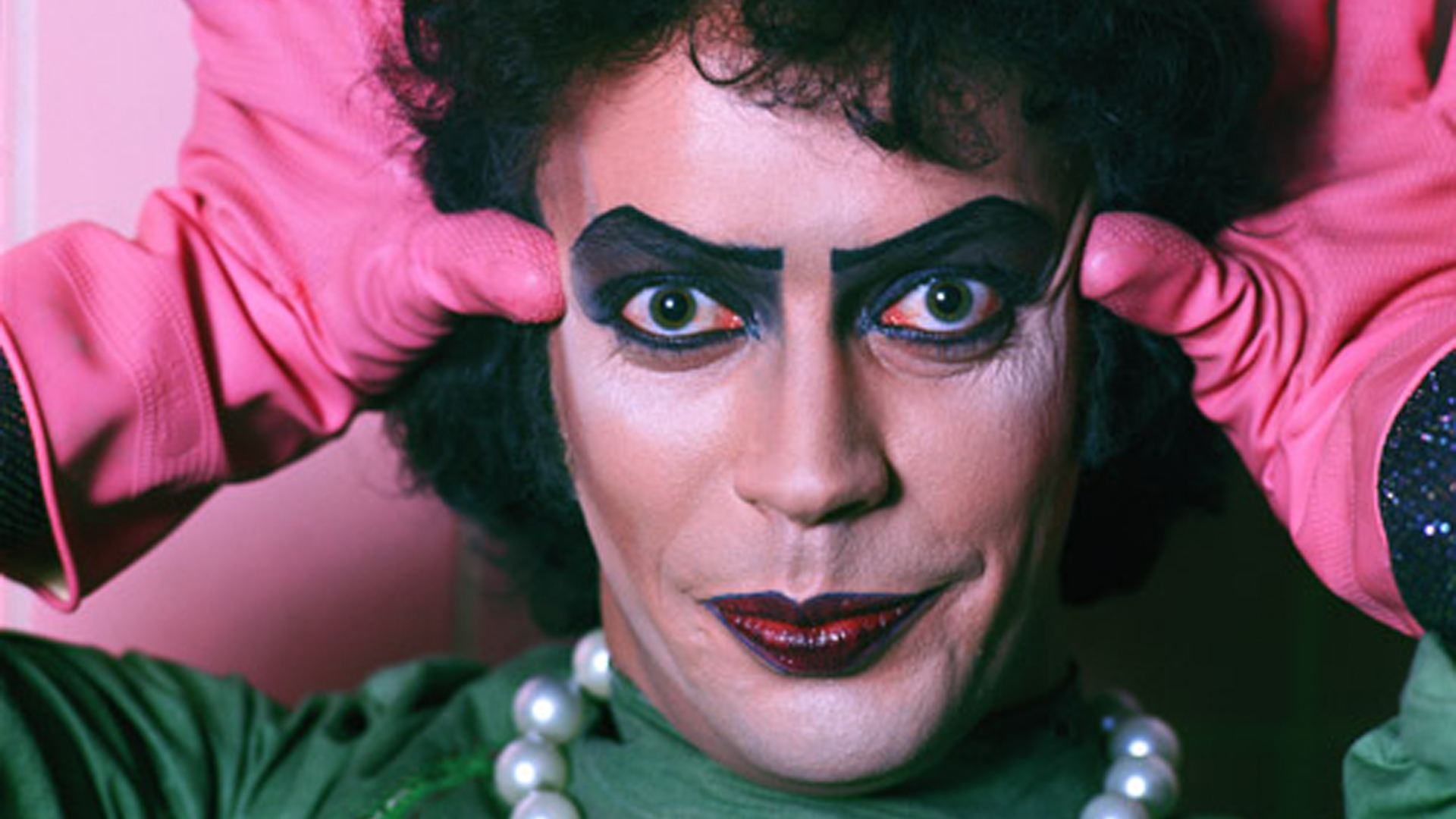
Corset. Pearls. Fishnets. High heels. Red lipstick.
And perhaps one of the greatest entrances in cinema history.
For millions of people around the world, that was their introduction to Tim Curry.
The legendary British actor, singer and performer died on 25 August 2026 at the age of 80, leaving behind an extraordinary career across theatre, film, television and voice acting. Curry earned three Tony Award nominations and became unforgettable in roles ranging from Wadsworth in Clue to Pennywise in It, Darkness in Legend and countless voice performances.
But for queer culture, there will always be one character who stands apart.
Dr Frank-N-Furter.
Curry first played Frank in the original London production of The Rocky Horror Show in 1973 before bringing the character to the screen in The Rocky Horror Picture Show in 1975. The film eventually became a cult phenomenon, particularly through its famous midnight screenings and audience participation.
For generations of LGBTQ+ people, Frank represented something exhilarating: the possibility of being theatrical, sexual, gender-defying, excessive, strange and completely unapologetic about it.
He didn’t ask permission to be different.
And perhaps that is exactly why we never forgot him.
Imagine Seeing Frank-N-Furter in 1975.
It is difficult to understand the impact of The Rocky Horror Picture Show without remembering when it appeared.
This was 1975.
And suddenly there was Tim Curry, striding across the screen in lingerie, pearls and high heels, sexually confident, gloriously theatrical and almost completely uninterested in conventional ideas of masculinity.
Frank-N-Furter did not simply bend the rules.
He seemed to treat the rules as if they had never really mattered in the first place.
At a time when LGBTQ+ visibility in mainstream cinema was still limited and often shaped by shame, secrecy or tragedy, Frank offered something radically different: spectacle, confidence, humour and desire.
He was not asking the audience to approve of him.
He was inviting them into his world.
And that distinction mattered.
For many viewers, especially queer viewers, Rocky Horror offered one of the first mainstream glimpses of a character who could be sexually ambiguous, gender-defying, outrageous and still completely magnetic.
Frank was dangerous, ridiculous, seductive, theatrical and unforgettable.
But above all, he was free.
Camp Without Apology.
Queer culture has always understood the power of camp.
Camp can be funny.
Camp can be outrageous.
Camp can also be deeply subversive.
It takes the rules of respectability, exaggerates them until they collapse and then dances on top of the ruins in six-inch heels.
Tim Curry understood that instinctively.
His Frank-N-Furter was funny without becoming merely a joke.
Sexy without asking audiences to categorise exactly what they were attracted to.
That combination is part of what made the performance so enduring.
Frank was not simply “different”. He made difference look powerful, theatrical and desirable.
For queer audiences, that mattered enormously.
Because sometimes representation is not about seeing a perfectly realistic version of yourself on screen.
Sometimes it is about seeing someone break every rule you were told you had to follow — and discovering that the result can be spectacular.
A Door Opened for Generations.
For many people, The Rocky Horror Picture Show eventually became far more than a film.
Its midnight screenings turned into communal rituals.
Audiences dressed as the characters.
They shouted back at the screen.
They sang along.
They performed scenes in front of the cinema.
And, perhaps most importantly, they found each other.
For generations of LGBTQ+ people, Rocky Horror created a space where being different was not something to hide.
It was something to celebrate.
That sense of community became one of the film’s most important legacies.
People who might have felt out of place in everyday life could walk into a screening and suddenly find themselves surrounded by others who also understood the appeal of being strange, theatrical, loud, sexual, funny or simply impossible to categorise.
For some, it was just entertainment.
For others, it was one of the first places where difference felt exciting rather than shameful.
And at the centre of all of that was Tim Curry’s Frank-N-Furter.
A character who was never designed to be respectable.
And became unforgettable precisely because of it.
More Than Frank-N-Furter.
Tim Curry’s place in queer cultural history will always be tied to Frank-N-Furter, but his career was far broader than one unforgettable performance.
He moved effortlessly between theatre, film, television and voice acting, bringing the same unmistakable presence to every role.
There was Wadsworth in Clue.
There was the terrifying Pennywise in It.
There was Darkness in Legend.
There were major stage roles, musical performances and decades of distinctive voice work.
What made Curry special was his ability to make a character feel instantly larger than life without losing control of the performance.
He could be sinister, funny, theatrical, absurd, elegant or completely unhinged — sometimes all at once.
That versatility is part of why so many of his performances have remained cult favourites.
But Frank-N-Furter belongs to a different category. That performance did not simply become famous. It became culture. And, specifically, queer culture.
Don’t Dream It. Be It. Perhaps that is ultimately why Tim Curry’s performance mattered so much.
Frank-N-Furter showed audiences a world in which identity could be theatrical, sexuality could be playful and difference could be something to celebrate rather than conceal.
For generations of queer people, that was powerful.
Not because Frank was meant to represent every LGBTQ+ experience.
He clearly did not.
But because he represented possibility.
The possibility of refusing conventional expectations.
The possibility of enjoying your own difference.
The possibility of walking into a room and deciding that the rules did not have to define you.
Tim Curry never needed to carry the burden of representing an entire community.
He simply gave one extraordinary performance.
And queer culture did the rest.
Fifty years later, somewhere tonight, somebody will put on fishnets for the first time, walk into a Rocky Horror screening and discover that being different can actually be rather magnificent.
To provide the best experiences, we use technologies like cookies to store and/or access device information. Consenting to these technologies will allow us to process data such as browsing behavior or unique IDs on this site. Not consenting or withdrawing consent, may adversely affect certain features and functions.
Functional
Always active
The technical storage or access is strictly necessary for the legitimate purpose of enabling the use of a specific service explicitly requested by the subscriber or user, or for the sole purpose of carrying out the transmission of a communication over an electronic communications network.
Preferences
The technical storage or access is necessary for the legitimate purpose of storing preferences that are not requested by the subscriber or user.
Statistics
The technical storage or access that is used exclusively for statistical purposes.The technical storage or access that is used exclusively for anonymous statistical purposes. Without a subpoena, voluntary compliance on the part of your Internet Service Provider, or additional records from a third party, information stored or retrieved for this purpose alone cannot usually be used to identify you.
Marketing
The technical storage or access is required to create user profiles to send advertising, or to track the user on a website or across several websites for similar marketing purposes.