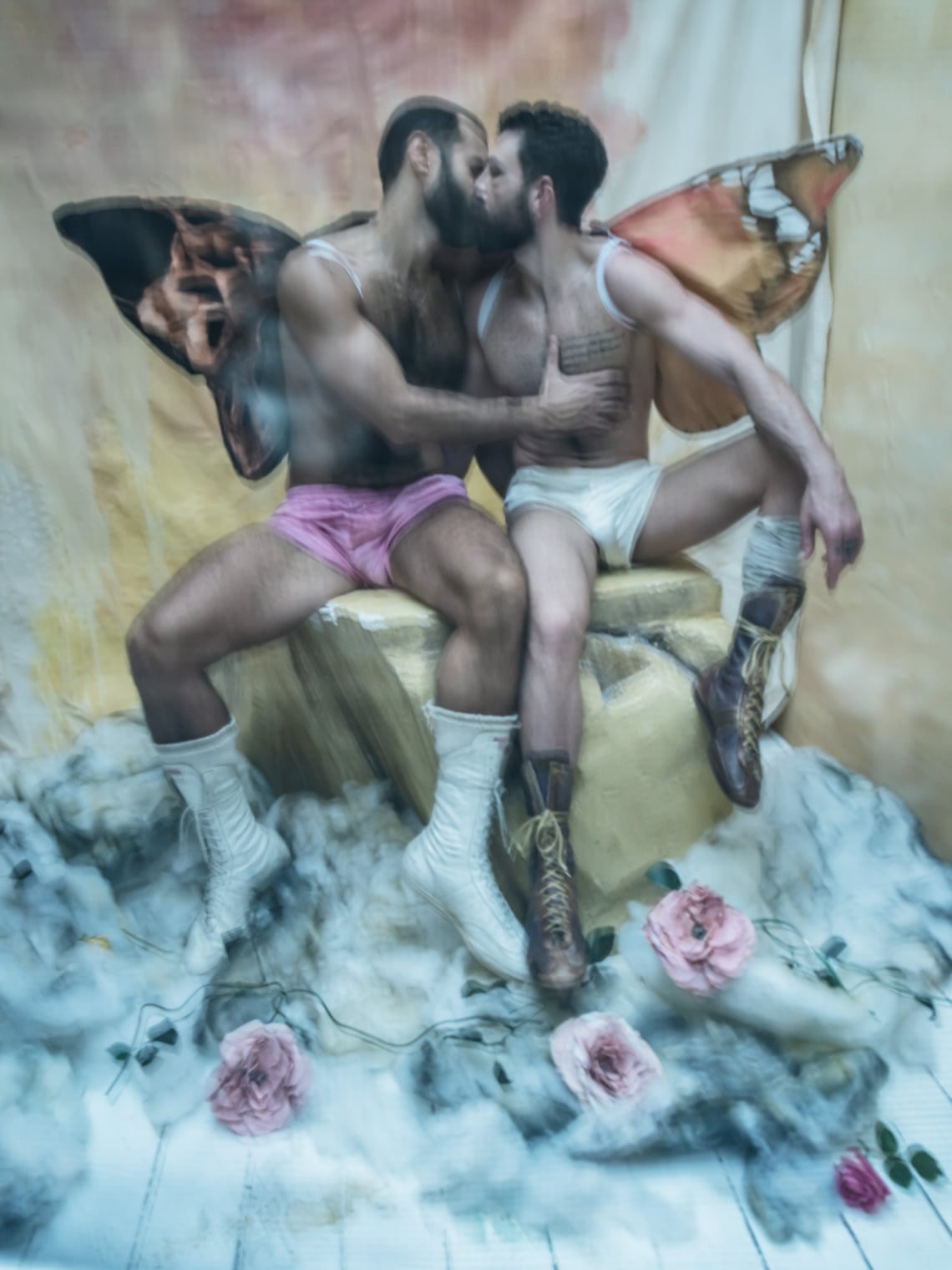
Tim Walker’s Fairyland is about to open at London’s National Portrait Gallery, bringing together more than 250 portraits in one of the institution’s most ambitious celebrations of queer identity, community and love.
Tim Walker’s Fairyland: Love and Legends opens to the public on 9 October 2026 and runs until 7 February 2027. Created over five years, the project features LGBTQ+ activists, writers, artists and performers alongside famous faces including Ian McKellen, Chappell Roan, Miriam Margolyes and Isaac Julien.
But calling this simply another celebrity photography exhibition would rather miss the point.
Walker has taken the dreamlike visual language that made his fashion photography instantly recognisable and turned it towards something deeply personal: more than fifty years of queer history, activism, survival and imagination.
The National Portrait Gallery describes Tim Walker’s Fairyland as an exploration of queer identity, community and love.
Walker rose to prominence during the 1990s through elaborately constructed photographs inspired by fairytales, theatrical sets and surreal fantasy. His images have appeared in publications including Vogue, Vanity Fair, W, LOVE and i-D, and he has photographed everyone from Lady Gaga and Hunter Schafer to Frank Ocean and the Pet Shop Boys.
For Fairyland, however, the fantasy has a different purpose.
The exhibition is built around 250 specially created portraits and five years of conversations with queer people and allies in Britain and beyond. Rather than treating LGBTQ+ history as something that belongs exclusively to archives, Walker transforms it into something alive, theatrical and defiantly beautiful.
From gay liberation to the AIDS crisis
Part of the project’s inspiration came from Walker discovering a plaque commemorating an early British gay liberation demonstration.
The connection became intensely personal because the protest took place in 1970, the same year Walker was born. He has spoken about growing up gay through the fear, stigma and homophobia surrounding the HIV/AIDS crisis, experiences that now sit beneath the extravagant surface of the exhibition.
That gives Fairyland a tension that makes it considerably more interesting than simple visual escapism.
There are costumes, flowers, fantastical landscapes and theatrical characters, but behind them are real histories of activism, illness, discrimination and community survival.
Figures connected to Britain’s HIV/AIDS story sit alongside performers and contemporary queer cultural icons, creating what Walker has described through his work as a kind of tapestry of queer British life.
Ian McKellen, Chappell Roan and queer legends meet
Among the exhibition’s best-known sitters are Sir Ian McKellen, Chappell Roan, Miriam Margolyes and filmmaker Isaac Julien.
But celebrity is not the organising principle.
The project deliberately places internationally famous queer figures alongside activists and people whose contributions to LGBTQ+ history may be less familiar to mainstream audiences. That choice allows Fairyland to operate simultaneously as spectacle and historical storytelling.
The accompanying publication expands that approach further, with contributions from queer writers and creators including Travis Alabanza, Russell T Davies, Shon Faye, Lisa Power and Joelle Taylor.
Why Tim Walker’s Fairyland matters now
There is something especially timely about Tim Walker’s Fairyland arriving in 2026.
Much contemporary discussion around LGBTQ+ people is dominated by legislation, court cases, restrictions, political arguments and culture-war headlines. Those stories matter enormously, and TGM covers them every day, but they can also accidentally reduce queer existence to an endless list of things being debated or taken away.
Walker offers something different.
In Fairyland, queer people do not exist to justify themselves to politicians, commentators or courts. They are the subject, the history, the fantasy and the art.
That does not erase the darker parts of queer British history. Instead, it places them beside joy, sex, creativity, camp, resilience and beauty.
Frankly, there is something rather radical about refusing to remember queer people only through suffering.
When and where is Tim Walker’s Fairyland?
Tim Walker’s Fairyland: Love and Legends opens at the National Portrait Gallery in London on 9 October 2026 and runs until 7 February 2027.
The exhibition is located on Floor 0. Standard tickets currently start at £23 off-peak and £25 at peak times, with optional donation prices also available.
More than 250 portraits, fifty years of queer history and Tim Walker being allowed to let his imagination completely off the leash?
Yes, babes. This one belongs on the queer London calendar.
To provide the best experiences, we use technologies like cookies to store and/or access device information. Consenting to these technologies will allow us to process data such as browsing behavior or unique IDs on this site. Not consenting or withdrawing consent, may adversely affect certain features and functions.
Functional
Always active
The technical storage or access is strictly necessary for the legitimate purpose of enabling the use of a specific service explicitly requested by the subscriber or user, or for the sole purpose of carrying out the transmission of a communication over an electronic communications network.
Preferences
The technical storage or access is necessary for the legitimate purpose of storing preferences that are not requested by the subscriber or user.
Statistics
The technical storage or access that is used exclusively for statistical purposes.The technical storage or access that is used exclusively for anonymous statistical purposes. Without a subpoena, voluntary compliance on the part of your Internet Service Provider, or additional records from a third party, information stored or retrieved for this purpose alone cannot usually be used to identify you.
Marketing
The technical storage or access is required to create user profiles to send advertising, or to track the user on a website or across several websites for similar marketing purposes.
 Skip to content