Where do LGBTQ+ Catholics fit into the conversation?
Pope Leo and LGBTQ+ Catholics are back at the centre of attention after the pontiff opened the largest gathering of Catholic leaders of his papacy so far, bringing around 150 bishops from more than 115 countries to Rome for a week of discussions about family life, marriage and the Church’s response to people whose lives do not fit neatly into traditional Catholic structures.
The meeting, which runs from 7 to 14 October, marks ten years since Pope Francis published Amoris Laetitia, his influential document on love, marriage and family life.
Reuters reports that questions surrounding gay Catholics, as well as divorced and remarried Catholics, are expected to form part of the wider discussions, although LGBTQ+ inclusion is not a separate formal item on the published agenda. That distinction matters. This is not a Vatican summit called specifically to rewrite Catholic teaching on homosexuality, nor has Pope Leo announced any change in doctrine.
What he has done is ask bishops to confront difficult questions honestly.
And for LGBTQ+ Catholics, that may be worth watching.
What is Pope Leo’s Vatican meeting actually about?
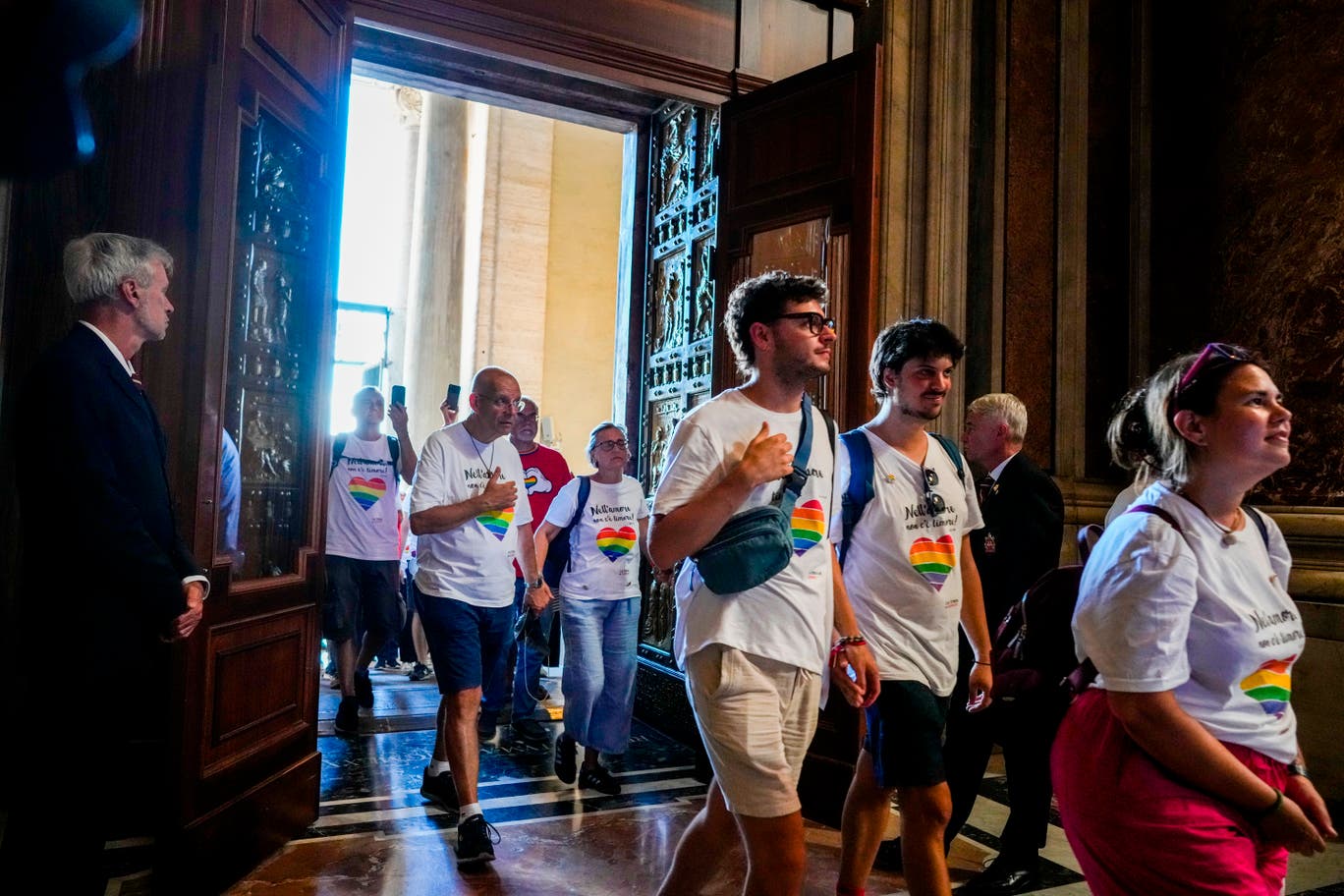
LGBTQI+ catholic representatives entering Saint Peter’s Cathedral in Rome
The official title of the gathering is “Ten Years After Amoris Laetitia: Proclaiming the Gospel With Families Today.”
It includes presidents of bishops’ conferences, heads of Eastern Catholic Churches, married couples, experts and facilitators from around the world.
In his opening address, Leo encouraged participants to examine what Catholic communities have learned over the past decade and to ask what sort of Church people encounter precisely when they are at their most vulnerable.
That may sound like classic Vatican language, but the questions he posed are actually quite revealing.
The Pope asked whether Catholic communities help people feel that they still have a place, responsibilities and gifts to offer, and whether Church teaching can be experienced through patience, closeness and mercy.
For LGBTQ+ Catholics who have spent years hearing variations of “you are welcome, but…”, the answer to those questions is hardly theoretical.
Where do LGBTQ+ Catholics fit into the conversation?
This is where things become more complicated.
The Catholic Church continues to teach that marriage is between a man and a woman. Nothing announced at this meeting changes that.
The official opening speech from Pope Leo also explicitly reaffirmed the traditional biblical understanding of male-female marriage.
At the same time, the meeting is deliberately designed to examine families and relationships that do not always fit comfortably within the Church’s ideal model.
Reuters reports that participants are expected to discuss how the Church responds to gay Catholics and to people who are divorced and remarried.
That does not mean bishops are preparing to approve same-sex marriage, nor would it be responsible to suggest that they are.
The more realistic question is pastoral: how does the Catholic Church treat LGBTQ+ people in practice?
Can queer Catholics participate fully in parish life? Are same-sex couples treated primarily as a “problem” to be managed, or as people with families, responsibilities and spiritual lives? What happens when official doctrine and the reality of modern family structures collide?
Those are not small questions, even if they do not immediately produce doctrinal revolution.
Amoris Laetitia changed the tone, but not every rule
Press conference for the 10th anniversary of Amoris Laetitia
When Pope Francis published Amoris Laetitia in 2016, the document became particularly notable for its emphasis on pastoral discernment rather than simply applying identical rules to every complicated family situation.
It encouraged clergy to accompany people whose lives differed from the Church’s ideal rather than treating every irregular situation in exactly the same way.
The document was particularly controversial because of its implications for divorced and remarried Catholics receiving the sacraments.
LGBTQ+ Catholics inevitably form part of that reality.
And this is why the gathering could matter even without a dramatic headline announcing that Church teaching has changed.
Pope Leo is asking bishops to listen before deciding
There is another interesting feature of the meeting.
The Vatican has specifically said that participants are not expected to erase disagreements simply to manufacture consensus.
Instead, differences, tensions and unanswered questions are supposed to be recorded and reflected in the final report.
That may sound bureaucratic, but in an institution where difficult questions can sometimes disappear beneath carefully controlled language, formally acknowledging disagreement matters.
Pope Leo also told bishops that situations which challenge the Church can themselves become places from which it learns.
Again, none of that automatically translates into policy change.
But it does establish a framework where questions about queer Catholics can be raised without pretending that every part of the global Church already agrees on the answers.
And clearly, it does not.
So, is the Vatican changing its position on LGBTQ+ people?
Right now, no major doctrinal change has been announced.
That is probably the most important sentence in this article.
There will inevitably be headlines suggesting that Pope Leo is preparing some enormous shift on homosexuality simply because LGBTQ+ Catholics may be discussed. That would be getting ahead of the evidence.
What we actually have is a major global Catholic meeting, convened personally by Pope Leo, asking bishops to examine how the Church accompanies modern families and people living complicated realities.
Gay Catholics are expected to be part of that conversation.
The final report may tell us much more about how significant that conversation becomes.
For now, the story is not that the Catholic Church has suddenly rewritten its rules.
It is that Pope Leo is asking the Church to talk about the people who do not fit those rules quite so neatly.
For LGBTQ+ Catholics, what bishops choose to say when the doors close may prove considerably more interesting than another rainbow-coloured Vatican headline.
To provide the best experiences, we use technologies like cookies to store and/or access device information. Consenting to these technologies will allow us to process data such as browsing behavior or unique IDs on this site. Not consenting or withdrawing consent, may adversely affect certain features and functions.
Functional
Always active
The technical storage or access is strictly necessary for the legitimate purpose of enabling the use of a specific service explicitly requested by the subscriber or user, or for the sole purpose of carrying out the transmission of a communication over an electronic communications network.
Preferences
The technical storage or access is necessary for the legitimate purpose of storing preferences that are not requested by the subscriber or user.
Statistics
The technical storage or access that is used exclusively for statistical purposes.The technical storage or access that is used exclusively for anonymous statistical purposes. Without a subpoena, voluntary compliance on the part of your Internet Service Provider, or additional records from a third party, information stored or retrieved for this purpose alone cannot usually be used to identify you.
Marketing
The technical storage or access is required to create user profiles to send advertising, or to track the user on a website or across several websites for similar marketing purposes.
 Skip to content