 Skip to content


The Taipei gay bar raid that sparked outrage across Taiwan’s LGBTQ+ community has entered a new and potentially much more serious phase, with activists asking prosecutors to investigate whether police officers themselves broke the law during the operation.
On 7 October, the Taiwan Forward Alliance filed a criminal complaint with the Taipei District Prosecutors Office over the 3 October raid on Commander D, a gay and BDSM bar in Taipei’s Wanhua district.
The complaint alleges possible illegal search, coercion and unlawful deprivation of liberty, shifting the controversy beyond offensive police behaviour and into a direct legal challenge over the way the raid itself was conducted. Prosecutors have been asked to preserve CCTV footage, officers’ body-camera recordings and other evidence.
No officer has been found guilty of those allegations, and the complaint does not itself establish criminal wrongdoing. Taipei police continue to maintain that the original operation was conducted pursuant to a lawful search warrant.
What is no longer in dispute, however, is that the authorities have already identified serious problems with officers’ conduct.
What happened during the Taipei gay bar raid?
Police entered Commander D on 3 October following complaints and an investigation into possible public-decency offences.

The operation resulted in 51 people being taken from the venue for questioning, while the bar’s owner was arrested. Police said the raid related to alleged nudity and sexual or “lewd” conduct in a publicly accessible venue.
But attention quickly shifted from what police were investigating to how officers behaved during the raid.
Video and testimony circulated showing or describing officers ordering customers to kneel, attempting to prevent filming and making insulting comments. One particularly controversial remark questioned how a disabled patron could have sex, prompting widespread accusations of both homophobia and ableism.
Around 100 protesters subsequently gathered outside the Wanhua police precinct, demanding accountability and arguing that the operation had shattered their sense of safety in a city internationally associated with LGBTQ+ visibility.
Six police officials have now been disciplined
Taipei police reviewed body-camera footage after the backlash and confirmed disciplinary action involving six police officials.
Four officers received two reprimands each over inappropriate language during the operation. The leader of the investigative team was also disciplined, while Wanhua Precinct chief Chen Yung-hua received two reprimands in connection with supervisory responsibility.
Police chief Lin Yen-tien has maintained that the search itself was lawful, but acknowledged that four officers used inappropriate language.
Taipei Mayor Chiang Wan-an expressed regret over the officers’ conduct and apologised to people affected by it, while insisting that Taipei remains committed to equal treatment regardless of sexual orientation or identity.
For LGBTQ+ organisations, however, internal disciplinary action was not enough.
Why activists say the Commander D raid may have crossed a legal line
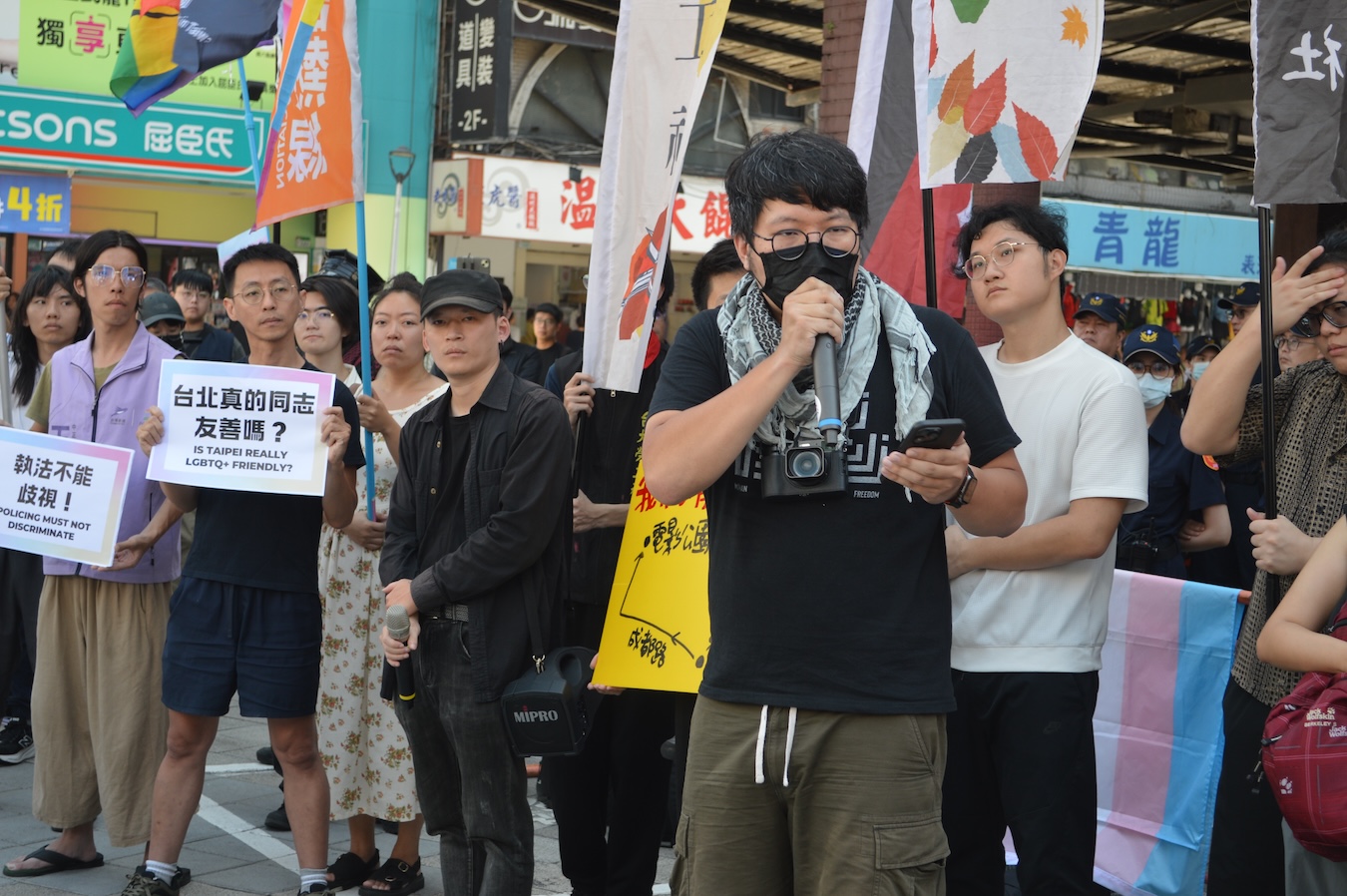
The new complaint focuses heavily on what happened to people who were inside Commander D but were not necessarily the target of the original search warrant.
Lawyer and campaigner Lee Hui-hsuan, speaking for the Taiwan Forward Alliance, argued that police showed the warrant to the venue operator but did not show it individually to the other people who were subsequently controlled and taken to the police station.
The complaint alleges that patrons were prevented from leaving, told not to communicate, stopped from recording and required to submit to searches of personal belongings without sufficient legal justification. Campaigners argue that some of those actions could potentially amount to coercion or unlawful deprivation of liberty.
Again, these are allegations now being put before prosecutors, not findings of fact.
That distinction is crucial, but so is the change in the nature of the controversy. The question is no longer simply whether some officers behaved offensively.
Prosecutors are now being asked to consider whether police powers themselves were exercised lawfully.
LGBTQ+ groups want more than an apology
Taiwanese LGBTQ+ rights organisations have also called for an independent investigation involving legal, human-rights, gender-equality and community representatives, rather than leaving the entire review process within the police structure.
The Taiwan Alliance to Promote Civil Partnership Rights has gone further, arguing that the incident exposes wider problems in laws concerning concepts such as “public morals”, “obscenity” and “indecency”.
The organisation says vague morality-based provisions can leave too much space for selective enforcement influenced by mainstream attitudes towards sexuality.
That question could ultimately give the Taipei gay bar raid significance far beyond Commander D.
If a legal framework allows intimate or queer spaces to face disproportionate scrutiny under broadly defined morality provisions, campaigners argue that disciplining a handful of officers will not address the structural problem.
The timing before Taiwan Pride could hardly be more awkward

Taiwan has spent years building an international reputation as one of Asia’s most LGBTQ-friendly societies.
It became the first country in Asia to legalise same-sex marriage in 2019, while Taipei hosts one of the region’s largest Pride celebrations.
That makes the Commander D controversy particularly uncomfortable.
The raid happened during the same month that thousands of LGBTQ+ people are preparing to travel to Taipei for Pride, and activists have argued that a city cannot promote itself as queer-friendly during Pride while LGBTQ+ customers fear discriminatory treatment by law enforcement.
The issue has also attracted attention elsewhere in Asia, where LGBTQ+ organisations have warned that the incident risks damaging Taiwan’s reputation as a regional example of equality.
What happens next in the Taipei gay bar raid case?
The complaint filed on 7 October asks the Taipei District Prosecutors Office to open an investigation, identify the officers involved and secure video evidence before it can be lost.
That does not mean charges will automatically follow. Prosecutors must first decide how to handle the allegations and whether the evidence supports further criminal proceedings.
Meanwhile, Taipei police say they will await the outcome of the judicial process, while maintaining that the original search was legally authorised.
For TGM, that is the key development.
The Taipei gay bar raid began as a story about a controversial police operation. It then became a story about discriminatory language, public protest and six disciplinary sanctions.
Now it is a potential legal case about the limits of police power.
And in a place frequently held up as one of Asia’s LGBTQ+ success stories, the answer could matter well beyond the doors of one Taipei bar.


