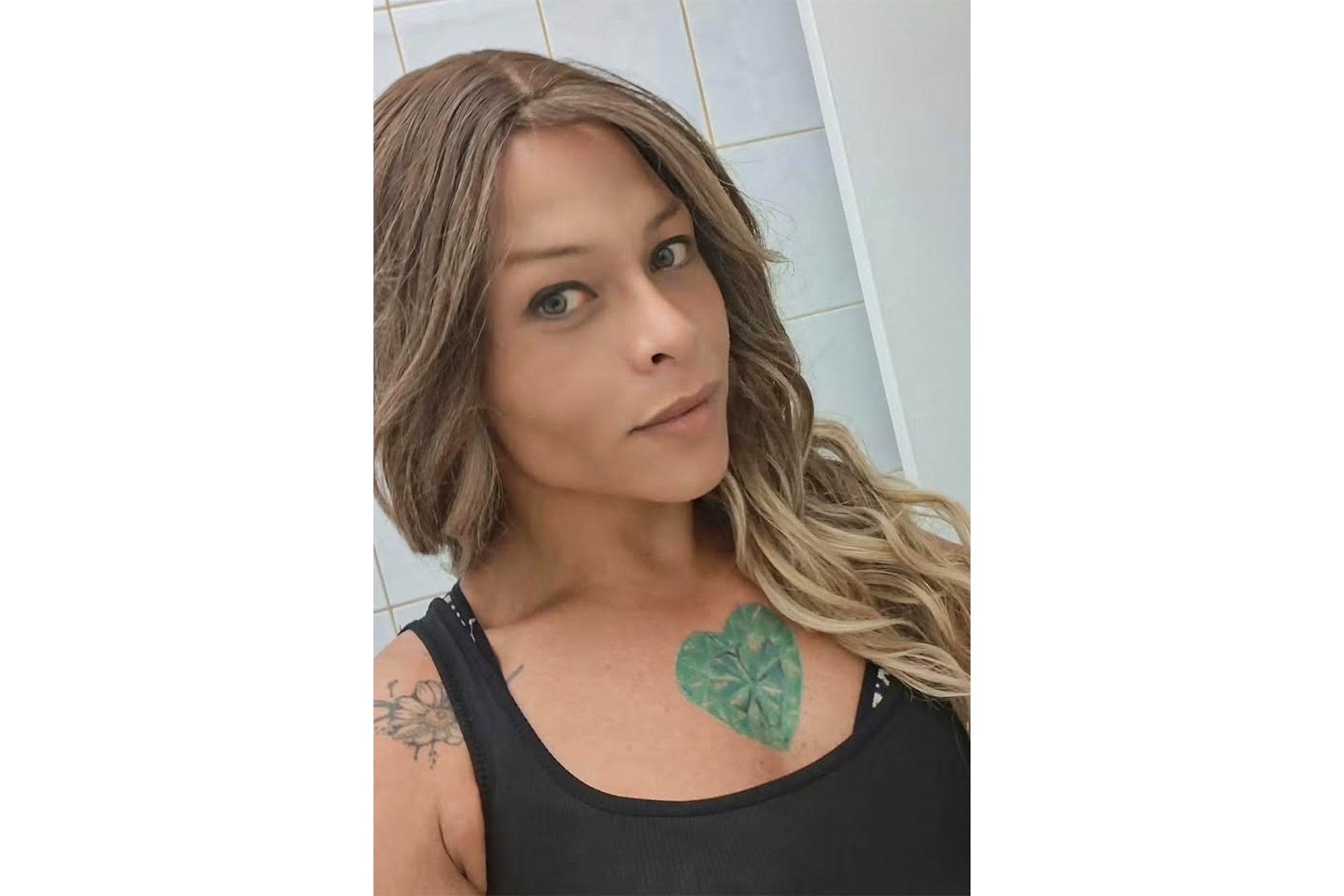
Today, the 32-year-old Cuban woman is more than 6,000 miles away in the Central African Republic, a country she had never lived in, had no connections to and, she says, had barely heard of before the United States deported her there on 29 August.
Her life now looks very different.
Fuentes says she wears men’s clothing, lowers her voice in public and tries not to attract attention to her body. Her blond wig, once part of her everyday life in Miami, is now something she feels safe wearing only in the privacy of a bathroom. She spends most of her time inside a compound in Bangui, sharing a room with four Cuban men who were also deported from the United States.
The contrast is difficult to miss.
A woman who once performed on stage in Miami is now trying to make herself less visible simply to feel safe.
Who is Daniela Fuentes?
Daniela Fuentes grew up in La Lisa, on the outskirts of Havana, and told the Associated Press that she began living as a woman during adolescence and started hormone treatment at 18.
Daniela Fuentes in an image shared on social media.
She ran a hair salon from her home in Cuba, but says she faced harassment because of her gender identity and was physically attacked on at least two occasions. In 2023, amid Cuba’s economic crisis and broader political tensions, she sold her home and left the country. AP News
During her journey through Central America, Fuentes says she presented as male because she believed doing so would make travelling safer.
After spending seven months in Mexico, she entered the United States through Texas using CBP One, the appointment system introduced during the Biden administration that allowed some migrants to enter temporarily on humanitarian grounds.
Then she moved to Miami.
There, she began presenting openly as a woman again, styling hair and performing in drag at Azúcar. She did not have permanent immigration status, but she told AP that Miami gave her something she had rarely experienced before, the ability to go about everyday life as herself. AP News
That ended after immigration authorities encountered her outside a motel.
Fuentes says she was detained with men
Authorities discovered that Fuentes had missed an immigration court hearing in Texas.
Public records reviewed by AP show that an immigration judge subsequently ordered her to leave the United States, although the records did not provide detailed information about the underlying proceedings. Fuentes says she had asked for her immigration case to be transferred to Florida but received no response.
After being detained, she says immigration officials placed her in facilities with male detainees.
Her wig was confiscated and she was given a male detainee uniform.
That treatment is consistent with a January 2025 executive order directing federal authorities to classify detainees according to sex rather than gender identity in detention settings.
Fuentes was held first in Florida, then transferred to Texas.
She knew she might be deported when armed officers arrived, but says she still did not know where she was going.
According to her account, she only learned that the plane was heading to Africa around five hours into the flight. Other deportees interviewed by AP gave similar accounts of not knowing their destination before boarding.
On 29th August, Daniela Fuentes arrived in the Central African Republic.
She had no family there, no established immigration status there and no personal connection to the country.
What is life like for a trans woman in the Central African Republic?
The Central African Republic does not have the same legal framework for LGBTQ+ people that Fuentes encountered in Miami.
Private consensual same-sex relations are not comprehensively criminalised, but the country has criminalised certain public same-sex expressions of affection. Previous US State Department reporting has also documented no legal protection against discrimination based on sexual orientation or gender identity and no legal mechanism allowing transgender people to change the gender marker on official documents.
Social stigma also remains significant.
Fuentes says she rarely leaves the compound where deportees are being housed. When she does, her lack of identification creates another problem because she fears encounters with police.
She and other deportees say they cannot legally work because they do not possess the necessary documents. The International Organization for Migration has supplied food, while members of the group have also relied on donations to buy groceries. AP News
On one trip to a supermarket, Fuentes says workers pointed at her breasts and initially refused to sell her fruit. She has also described people in Bangui mocking or pointing at her.
So she adapts.
Men’s clothing.
A lower voice.
Less visibility.
A life deliberately made smaller.
Daniela Fuentes is not an isolated case
Her story appeared on the same day that Human Rights Watch published a 125-page investigation into US deportations to third countries in Africa.
The organisation found that more than 500 people were transferred from the United States to African countries between January 2025 and August 2026, despite those countries not being their homelands.
Among them were at least 12 people who identified as lesbian, gay, bisexual or transgender and who were sent to countries where same-sex relationships or public same-sex romantic conduct can be criminalised. Human Rights Watch says some of those deportees had previously received US protection because returning to their own countries could expose them to persecution linked to their sexual orientation or gender identity.
Human Rights Watch argues that many deportees were not given a meaningful opportunity to challenge the country to which the United States intended to send them, including by explaining why that third country might also expose them to persecution, torture or other serious harm.
Reuters separately documented 40 LGBTQ+ migrants affected by third-country deportations, including people sent to African states that criminalise same-sex relations or where US government reporting has previously documented serious abuses against LGBTQ+ people.
The US government says its third-country deportation policy is lawful and that receiving governments provide assurances that deportees will not be persecuted or tortured. ICE did not respond to AP’s questions specifically about Fuentes’ case.
Why was she sent to the Central African Republic?
That remains one of the strangest parts of Daniela Fuentes’ story.
The United States does deport Cuban citizens directly to Cuba. Deportation flights to Havana resumed under an agreement implemented in 2023 and have continued despite the difficult relationship between the two governments.
Fuentes herself says she does not understand why she was sent instead to the Central African Republic.
The Central African Republic is among a growing number of governments that have agreed to receive migrants deported by the United States who are not citizens of the receiving country.
Human Rights Watch describes these as third-country deportations and says agreements of this kind have increasingly become part of US immigration enforcement since Donald Trump returned to office in January 2025.
The Central African Republic has already accepted dozens of people under the arrangement.
A Foreign Ministry official told AP that deportees were in “good hands” and receiving support from the International Organization for Migration. The IOM says people can seek asylum in the country, seek assistance returning home or request help travelling somewhere else if they have legal authorisation to enter that country.
For Fuentes, however, none of those options currently provides an easy answer.
Cuba will take her back, but Fuentes does not want to return
Cuba has authorised Fuentes to return.
But she says the conditions that led her to leave have not disappeared.
She is therefore hoping for another possibility, potentially seeking asylum somewhere else, including Canada.
Until then, she remains in Bangui without a passport or ordinary identification documents, unable to work and uncertain about how long her current accommodation will remain available.
And that uncertainty is what makes her story about much more than one deportation.
When deportation means hiding who you are
Immigration law is complicated.
Governments have authority to enforce immigration rules, courts issue removal orders and individual cases can involve facts that are impossible to capture in a headline.
But Daniela Fuentes’ story raises another question altogether.
What responsibility does a government have when the person it deports is LGBTQ+, and the country chosen for that deportation offers little protection for who they are?
Human Rights Watch argues that international law prohibits governments from transferring people to places where they face a real risk of persecution, torture or serious harm, a principle known as non-refoulement. Its new report says the US third-country policy has failed to provide some deportees with sufficient opportunities to raise those risks before removal.
The US government disputes accusations that its policy violates legal protections and maintains that receiving countries provide safety assurances.
Those arguments will continue through courts, governments and international institutions.
Meanwhile, there is Daniela.
In Miami she styled hair.
She performed in drag.
She walked outside wearing her wig.
Now that wig comes out only when she is alone in a bathroom.
Whatever the eventual legal judgment on America’s third-country deportation policy, that transformation tells us something about its human consequences.
A woman who once felt free enough to be seen is now surviving by trying not to be.In Miami, Daniela Fuentes lived openly as a transgender woman. She worked as a hairstylist, performed in drag at the nightclub Azúcar and wore the clothes, hair and make-up that reflected the person she had understood herself to be since adolescence.
To provide the best experiences, we use technologies like cookies to store and/or access device information. Consenting to these technologies will allow us to process data such as browsing behavior or unique IDs on this site. Not consenting or withdrawing consent, may adversely affect certain features and functions.
Functional
Always active
The technical storage or access is strictly necessary for the legitimate purpose of enabling the use of a specific service explicitly requested by the subscriber or user, or for the sole purpose of carrying out the transmission of a communication over an electronic communications network.
Preferences
The technical storage or access is necessary for the legitimate purpose of storing preferences that are not requested by the subscriber or user.
Statistics
The technical storage or access that is used exclusively for statistical purposes.The technical storage or access that is used exclusively for anonymous statistical purposes. Without a subpoena, voluntary compliance on the part of your Internet Service Provider, or additional records from a third party, information stored or retrieved for this purpose alone cannot usually be used to identify you.
Marketing
The technical storage or access is required to create user profiles to send advertising, or to track the user on a website or across several websites for similar marketing purposes.
 Skip to content