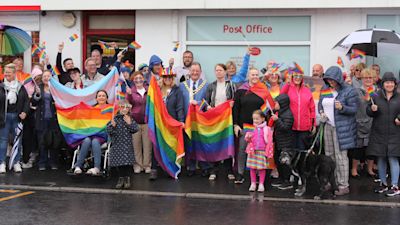
After what happened in Tucson, I asked myself: do we still need gay bars?
It is a question that also the whole LGBTQ+ community has been asking for years. We have dating apps in our pockets, Pride celebrations in hundreds of cities and, in many places, much greater visibility than previous generations could have imagined.
Finding someone for a date – or even something rather less romantic – no longer requires knowing which unmarked door leads downstairs to the local gay bar.
And yet, around the world, those doors are disappearing.
This week, the question suddenly feels more urgent.
Two men, Vincent Anthony Siqueiros and Cameron Davis Capara, were shot dead outside Venture-N, a long-established gay bar in Tucson, Arizona. Police are investigating the shooting as a possible hate crime after finding a note on the suspected gunman listing several LGBTQ+ associated businesses.
It was a horrifying act of violence. But it was also a reminder of something we sometimes forget: a gay bar is rarely just a bar.
Gay bars are disappearing and the numbers prove it
London offers one of the clearest examples.
Research by UCL Urban Laboratory, commissioned by the Mayor of London and Greater London Authority, found that the number of LGBTQ+ venues in the capital fell by 58% between 2006 and 2017 – from 125 venues to just 53.
More than half gone in little over a decade.
The researchers found that the reasons were far more complicated than the arrival of Grindr. Rising rents and business rates, redevelopment, changes in property ownership and the conversion of venues into other uses all played significant roles. They also found that spaces specifically serving women, trans people and LGBTQ+ people of colour were particularly vulnerable.
R-Bar in Brighton (UK)
The closures have not stopped.
In Brighton, one of Britain’s best-known LGBTQ+ destinations, R-Bar is closing after 21 years, while Charles Street Tap is closing after more than two decades, with rising costs among the pressures facing the businesses.
So this is not simply nostalgia for the Soho of twenty years ago. It is happening now.
Among its 147 respondents, 77% said the number of queer nightlife spaces in their area had decreased, while 82% said venue closures had damaged their sense of community.
Perhaps even more strikingly, only 7% felt well represented by the queer spaces still available to them. Six in ten believed queer nightlife receives insufficient government support.
I know, babes, it is a relatively small survey, so we should not pretend it represents every LGBTQ+ person in Britain.
But what those answers describe is familiar.
You can replace a club with flats. You can replace a pub with another restaurant. What is much harder to replace is the community that gathered inside it.
It is not just happening in Britain
Across the Atlantic, the pattern is strikingly similar.
Academic research into gay bars in the United States found that business listings declined by 41% between 2002 and 2019.
Then came Covid.
By spring 2021, researchers counted just 730 gay bars across the United States. There was some good news afterwards: that number recovered to 803 by 2023, suggesting LGBTQ+ nightlife is adapting rather than simply disappearing.
Again, there are signs of revival. New spaces and initiatives have appeared in recent years.
But you do not need to be particularly good at maths to see what was lost along the way.
Sydney tells the same story, but also offers some hope
Australia has its own version of the story.
Sydney’s Oxford Street became internationally synonymous with queer nightlife and the city’s LGBTQ+ history. Yet some of its most famous venues have disappeared.
ARQ, once described as Australia’s largest gay nightclub, closed after 26 years. Earlier this year, the Stonewall Hotel left Oxford Street after 28 years, following financial difficulties.
And yet Sydney’s queer nightlife has not vanished.
Parties, collectives and pop-up events are filling some of the gaps left by permanent venues. Organisers are finding railway arches, warehouses, temporary spaces and new neighbourhoods.
The scene is changing.
Perhaps that is the important distinction.
Queer nightlife is not dying. But the places that house it are becoming less permanent.
And bricks and mortar still matter.
Didn’t dating apps make gay bars unnecessary?
This is probably the most obvious argument.
Grindr arrived. Then came Scruff, HER, Tinder and countless other ways to meet people without leaving the sofa.
Suddenly, the gay bar was no longer the only place where you might discover that the handsome bloke across the room was also gay.
For some people, that was liberating.
You did not have to live in Soho, Manchester, Brighton or another big city to meet someone like yourself. Apps opened doors that geography had kept closed.
But researchers looking at London’s disappearing LGBTQ+ venues have specifically challenged the idea that digital apps simply made queer spaces obsolete. They found that physical LGBTQ+ venues continued to serve social, cultural and community functions that apps could not replace.
And that difference matters.
An app can help you find a date.
It cannot give an entire room a sense of belonging.
A gay bar was never only about finding someone
Ask different generations what their first gay bar meant to them and you will probably hear very different stories.
For some, it was terrifying.
For others, liberating.
For many, it was the first time they walked into a room and realised they were not the only one.
There is something powerful about that moment.
No checking whether it is safe to mention your boyfriend. No wondering whether holding someone’s hand will attract the wrong sort of attention. No mental calculation before casually saying “my husband”.
At its best, a queer space temporarily removes that calculation.
You can have a drink. Dance badly. Watch a drag queen absolutely murder someone in the front row. Be gloriously camp. Flirt. Talk rubbish with your mates, or just sit at the bar.
You do not actually have to do anything particularly queer.
That is rather the point.
But are gay bars really safe spaces?
This is where we should be careful.
Calling gay bars “safe spaces” can sound comforting, but history tells us that safety has never been guaranteed.
Even inside LGBTQ+ venues, people can experience racism, misogyny, transphobia, harassment or exclusion. Not every letter of the acronym has always felt equally welcome in every gay bar.
“Safe space” can therefore become too easy a phrase. Perhaps safer space is more accurate. A place where, ideally, one layer of vigilance can disappear. Where the assumption is not that you are straight until proven otherwise. Where you may be able to bring your whole self through the door rather than deciding which bits should stay outside.
Tucson reminds us that even those spaces can be attacked.
But perhaps that makes their existence more important, not less.
What disappears when a gay bar closes?
There is an economic story here, of course. Jobs disappear. Businesses close. Streets change.
But there is another loss that is harder to count.
Where does the newly out 19-year-old go to?
Where does the 60-year-old gay man who does not use dating apps meet his mates?
Where does the drag queen get her first booking?
Where does someone new to a city find their first bit of chosen family?
Where does a queer person who spends their working week editing themselves get to switch that filter off for a few hours?
Sometimes the answer will be a club. Sometimes a community centre, café, bookshop, Pride event, sports group, pop-up party or a room above a pub.
The 2026 Time Out and Gay Times research actually suggests that younger queer nightlife is already moving in this direction: towards collectives, temporary events and unconventional spaces rather than relying entirely on traditional gay bars: such a bittersweet reality, I know, but still serving hope, thou.
That evolution should be celebrated.
But it should not become an excuse to let every permanent queer venue disappear.
So, do we still need gay bars?
Maybe not in exactly the way we once did.
Society has changed. Technology has changed. We have changed.
For generations before us, gay bars were often one of the very few places where LGBTQ+ people could find one another at all.
Today, an app can put hundreds of potential dates within a few kilometres of your sofa.
Perhaps we no longer need gay bars to find love. But love was never the only thing we found there.
We found friends. Chosen family. Bad dates that became brilliant stories. Drag queens, activists, bartenders who knew our names and what our favourite drink was, exes we desperately tried to avoid and mates we somehow only ever saw after midnight.
We found THE scene, and with all its imperfections, drama, camp and contradiction…and sometimes, we found somewhere we did not have to explain ourselves.
We may no longer need gay bars to find love. But we may still need them to find each other, a place where we can feel at home, accepted and, hopefully, safe.
To provide the best experiences, we use technologies like cookies to store and/or access device information. Consenting to these technologies will allow us to process data such as browsing behavior or unique IDs on this site. Not consenting or withdrawing consent, may adversely affect certain features and functions.
Functional
Always active
The technical storage or access is strictly necessary for the legitimate purpose of enabling the use of a specific service explicitly requested by the subscriber or user, or for the sole purpose of carrying out the transmission of a communication over an electronic communications network.
Preferences
The technical storage or access is necessary for the legitimate purpose of storing preferences that are not requested by the subscriber or user.
Statistics
The technical storage or access that is used exclusively for statistical purposes.The technical storage or access that is used exclusively for anonymous statistical purposes. Without a subpoena, voluntary compliance on the part of your Internet Service Provider, or additional records from a third party, information stored or retrieved for this purpose alone cannot usually be used to identify you.
Marketing
The technical storage or access is required to create user profiles to send advertising, or to track the user on a website or across several websites for similar marketing purposes.
 Skip to content