Adam Lambert has reflected on the way George Michael responded when his sexuality was thrust into the public spotlight in 199, and why watching one of the world’s biggest male pop stars refuse to behave as though being gay was something shameful left such a lasting impression.
Lambert spoke about Michael following the 2026 MTV Video Music Awards, where he joined a star-studded tribute marking ten years since the singer’s death. Lambert closed the musical celebration with “Freedom! ’90”, alongside a line-up that included RAYE, Teddy Swims, Sombr, MNEK and Saint Harison.
For Lambert, however, the connection to George Michael goes considerably deeper than choosing the right song for an awards-show tribute.
Adam Lambert remembers George Michael coming out publicly
George Michael’s sexuality had been the subject of speculation long before 1998, but an arrest in Beverly Hills that year pushed his private life directly into the global media cycle. Michael subsequently spoke publicly about being gay rather than attempting to retreat from the story.
Lambert told People that what stayed with him was Michael’s confidence and refusal to appear ashamed. He remembers seeing somebody who had been placed in an intensely exposing situation respond by owning who he was rather than accepting the shame others might have expected him to carry.
For a younger queer generation watching at the time, that mattered.
The late 1990s were hardly devoid of openly gay public figures, but the landscape looked very different from today’s entertainment industry. George Michael was not an emerging niche artist speaking primarily to an LGBTQ+ audience. He was one of the most commercially successful male pop stars on the planet.
When somebody at that level said, effectively, that being gay was not the scandal, the cultural weight was different.
George Michael turned humiliation into something else
The circumstances surrounding Michael’s public coming out were far from ideal. Privacy and sexuality had collided with tabloid culture, and the story was presented internationally as celebrity scandal.
Michael eventually did what he had often done throughout his career: he took control of the narrative.
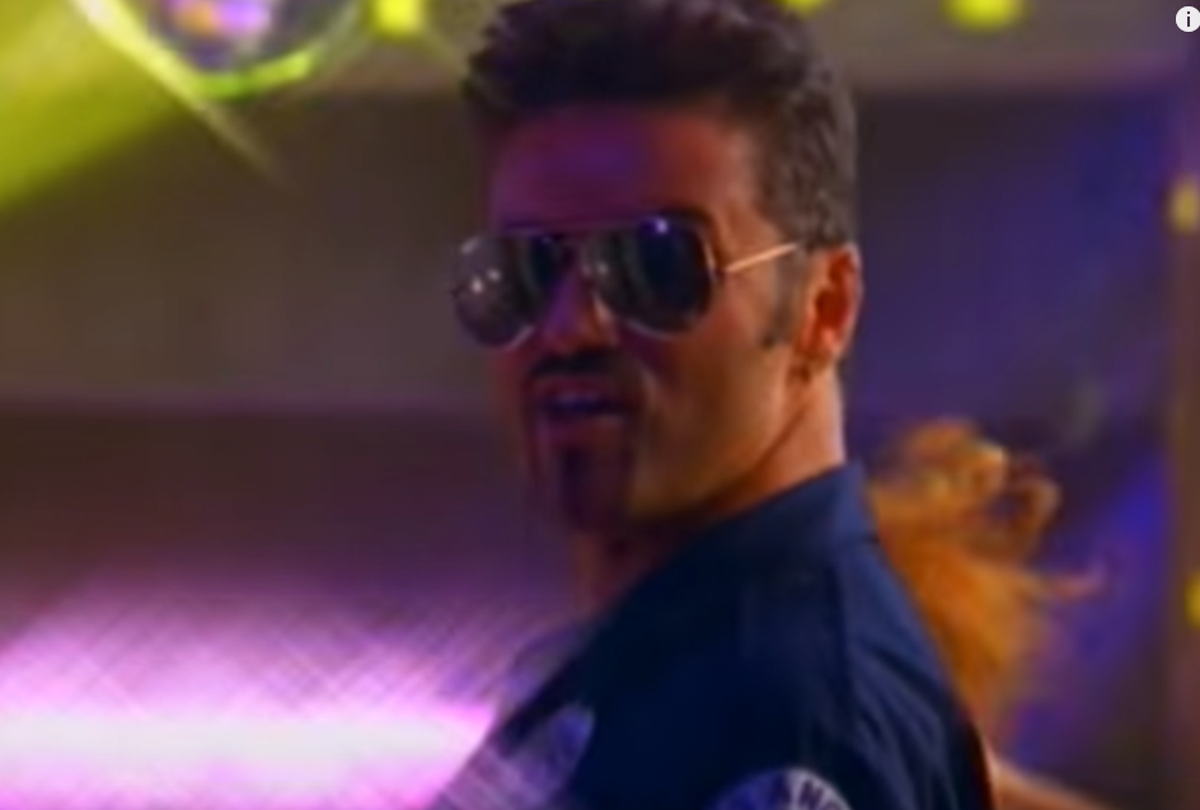
George Michael in his legendary video “Outside”
Rather than disappear, he incorporated the experience into his art and public persona, most famously with the knowingly irreverent video for “Outside” later in 1998. What could have become a permanent source of humiliation instead became another moment in which Michael played with celebrity, sexuality and the expectations placed on him.
That does not mean being involuntarily pushed into public disclosure should somehow be romanticised. Coming out should belong to the individual, on their own terms and in their own time.
What Lambert appears to remember so clearly is what Michael did after that choice had largely been taken away from him.
He refused to treat himself as the problem.
Why George Michael still matters to queer artists
Lambert has frequently spoken about the artists who influenced him, and Michael sits alongside names such as Freddie Mercury and David Bowie in a lineage of male performers who challenged expectations around sexuality, masculinity and pop stardom.
Adam Lambert – VMA’s show.
Their experiences were not identical, and neither were the eras in which they worked. But for openly queer male artists who followed, seeing somebody like George Michael occupy enormous mainstream cultural space had consequences.
At the VMAs, that legacy was visible again.
Lambert’s performance of Freedom! ’90 was particularly appropriate. The song was never originally written as a conventional gay anthem, yet its themes of image, identity and liberation have acquired additional resonance through Michael’s life and the way later generations understand his career.
There was nothing to apologise for
Pop culture has changed dramatically since 1998. Openly LGBTQ+ musicians now occupy spaces that would have been significantly harder to reach three decades ago, even if prejudice has by no means disappeared.
That makes looking backwards useful.
George Michael did not choose the circumstances under which millions of people suddenly became interested in his sexuality. But he did have some control over what happened next.
And what Adam Lambert remembers is not a man begging to be forgiven.
He remembers someone standing in the glare of an enormous media spotlight and behaving as though there was nothing about being gay that required an apology.
To provide the best experiences, we use technologies like cookies to store and/or access device information. Consenting to these technologies will allow us to process data such as browsing behavior or unique IDs on this site. Not consenting or withdrawing consent, may adversely affect certain features and functions.
Functional
Always active
The technical storage or access is strictly necessary for the legitimate purpose of enabling the use of a specific service explicitly requested by the subscriber or user, or for the sole purpose of carrying out the transmission of a communication over an electronic communications network.
Preferences
The technical storage or access is necessary for the legitimate purpose of storing preferences that are not requested by the subscriber or user.
Statistics
The technical storage or access that is used exclusively for statistical purposes.The technical storage or access that is used exclusively for anonymous statistical purposes. Without a subpoena, voluntary compliance on the part of your Internet Service Provider, or additional records from a third party, information stored or retrieved for this purpose alone cannot usually be used to identify you.
Marketing
The technical storage or access is required to create user profiles to send advertising, or to track the user on a website or across several websites for similar marketing purposes.
 Skip to content