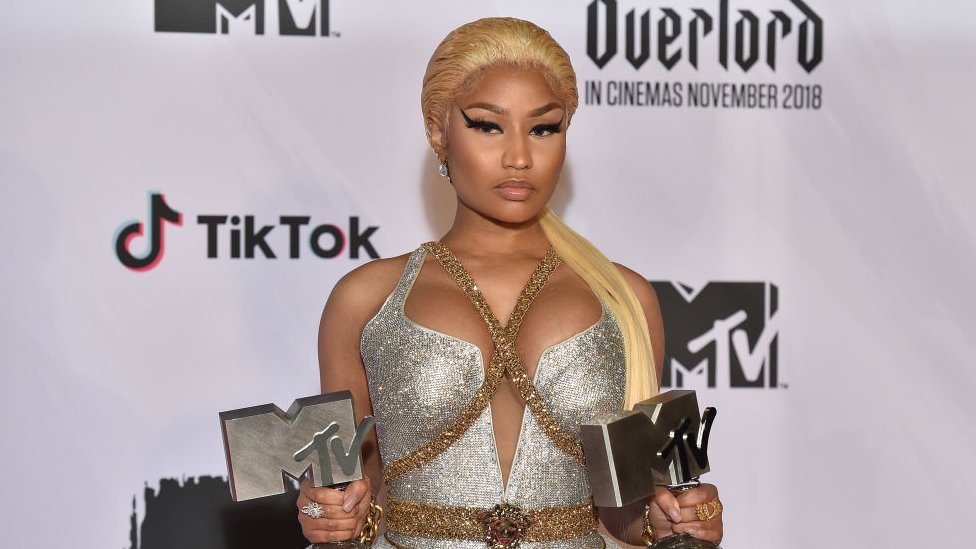
From queer icon to Trump’s political cheerleader, Nicki Minaj’s latest attack on transgender healthcare feels like a betrayal of the very community that helped build her career. And this time, the applause should not drown out the criticism.
There was a time when Nicki Minaj was celebrated as one of pop culture’s most recognisable queer icons.
Her music filled gay clubs. Drag queens performed her songs. LGBTQ+ fans embraced her extravagant alter egos, her fearless attitude and her unapologetic approach to self-expression.
Queer audiences didn’t just listen to Nicki Minaj. They helped turn her into a cultural phenomenon.
Today, many of those same fans are watching her stand alongside Donald Trump, praise his political agenda and repeat rhetoric targeting transgender young people.
And at The Gayly Mirror, we believe it is time to call this what it feels like: a betrayal.
Nicki Minaj Joins Trump and Attacks Transgender Healthcare
On Sunday, 25 October 2026, Minaj appeared alongside President Donald Trump at a Republican campaign rally in Port Huron, Michigan.
She praised his leadership, encouraged voters to support Republican candidates and promised him her continued loyalty.
But her most troubling remarks came when she turned her attention to transgender children.
“We don’t want our children to be bombarded with sex changes,” she told the crowd.
Her words echoed a familiar political narrative that reduces gender-affirming healthcare to frightening slogans about children undergoing unnecessary medical procedures.
In reality, gender-affirming care encompasses different forms of support, including psychological care, clinical assessment and, where appropriate under applicable medical guidelines, medical treatment.
It is an area of healthcare involving complex evidence, individual circumstances and ongoing professional debate.
Reducing all of that to a campaign slogan does nothing to improve public understanding. It simply turns vulnerable young people into political talking points.
Remember When Nicki Minaj Said She Supported LGBTQ+ Rights?
Perhaps the most striking part of this story is not what Minaj said in Michigan.
It’s what she used to say.
In July 2019, the rapper cancelled a scheduled concert in Saudi Arabia following criticism of the country’s human-rights record.
At the time, she publicly cited her support for women’s rights, LGBTQ+ equality and freedom of expression.
The decision was widely reported as a stand in solidarity with marginalised communities.
Fast-forward to October 2026, and the same artist is standing beside a president whose administration has introduced restrictions affecting transgender healthcare, military service and other aspects of LGBTQ+ life.
So what changed, Nicki?
Because the contradiction is impossible to ignore.
The LGBTQ+ Community Wasn’t Just Part of Her Audience
Let’s remember something important.
LGBTQ+ fans were not occasional spectators in Nicki Minaj’s rise to fame.
Gay men, drag performers, queer club audiences and LGBTQ+ creators helped establish her music, fashion and larger-than-life personality as cultural references.
Her songs became fixtures of queer nightlife. Her extravagant characters inspired performances, memes and countless moments of self-expression.
Minaj also appeared as a guest judge on RuPaul’s Drag Race, a programme built on the creativity and resilience of LGBTQ+ performers.
She benefited enormously from a cultural environment in which queer audiences celebrated everything about her that challenged conventional expectations.
And yes, Nicki’s talent, work and achievements remain her own.
But cultural icons do not exist in isolation from the communities that embrace them.
The relationship works both ways.
That is why her increasingly explicit support for political figures associated with restrictions on LGBTQ+ rights feels so personal to many former supporters.
You cannot embrace a community’s culture, enjoy its loyalty and then expect silence when you help promote politics that threaten some of its most vulnerable members.
This Is No Longer Just a Question of Different Political Opinions
Minaj has every right to express her political beliefs.
She can vote for whomever she chooses, endorse candidates and disagree with LGBTQ+ advocacy organisations.
But freedom of expression does not mean freedom from criticism.
And not every disagreement is simply a harmless difference of opinion.
The Trump administration has pursued policies restricting access to certain forms of gender-affirming healthcare, limiting transgender military service and challenging protections affecting LGBTQ+ people.
They concern access to medical care, employment, legal protections and the lives of real people.
When a global superstar publicly endorses those policies or reinforces the rhetoric used to defend them, her influence matters.
And when that superstar built such a close relationship with LGBTQ+ audiences, the sense of betrayal is entirely understandable.
Raffa, Editor-in-Chief: Why I Cannot Excuse This
“I want to be very clear about where I stand.
For me, Donald Trump represents a dangerous and relentless hunger for political power. I believe the consequences of his agenda extend far beyond the United States, affecting international relations, democratic institutions and the rights and security of vulnerable communities.
I see a leader whose pursuit of power has caused profound damage, not someone who deserves to be celebrated as a champion of freedom.
That is my editorial opinion, and I stand by it.
But my disappointment with Nicki Minaj goes beyond my view of Trump.
It comes from seeing an artist who has enjoyed years of loyalty, admiration and cultural support from LGBTQ+ audiences use her influence to endorse a political movement whose policies have threatened their rights.
I do not believe celebrities owe us agreement on every political question.
I do believe that when you have benefited from the love of a marginalised community, you have a responsibility not to use that love as a stepping stone towards people who are actively restricting its freedoms.
For me, this is not bravery. It is not independence. And it certainly is not empowerment.
It is turning your back on people who once celebrated you.”
Can Nicki Minaj Still Call Herself a Queer Icon?
There is no denying her influence on music and queer pop culture.
Her songs will continue to be played. Her performances remain part of pop history. Her artistic achievements cannot simply be erased.
But being embraced by LGBTQ+ audiences does not grant anyone a permanent exemption from accountability.
An artist’s relationship with a community can change when their public actions change.
Some LGBTQ+ fans continue to support Minaj and separate her music from her politics. Others have openly described her political transformation as a painful disappointment.
Both reactions exist.
But what Minaj cannot reasonably expect is for everyone who once celebrated her to ignore what she now says and does.
There is a difference between being a queer cultural icon and being an ally to queer people.
And in 2026, that difference has become painfully clear.
Nicki, You Cannot Have It Both Ways
Nicki Minaj is entitled to her politics, her convictions and her choices.
But LGBTQ+ fans are equally entitled to withdraw their support.
The community that helped make her music a cultural phenomenon does not owe her unconditional loyalty, particularly when she lends her voice to rhetoric used against transgender people.
This is bigger than one rapper, one concert or one political rally.
It is about what solidarity actually means when supporting LGBTQ+ rights becomes politically inconvenient.
And it is about whether celebrities who profit from queer culture are willing to stand beside queer people when their rights are under threat.
Nicki Minaj may have chosen her political side. But she should not be surprised if some of the people who helped build her throne no longer want to stand beside it.
To provide the best experiences, we use technologies like cookies to store and/or access device information. Consenting to these technologies will allow us to process data such as browsing behavior or unique IDs on this site. Not consenting or withdrawing consent, may adversely affect certain features and functions.
Functional
Always active
The technical storage or access is strictly necessary for the legitimate purpose of enabling the use of a specific service explicitly requested by the subscriber or user, or for the sole purpose of carrying out the transmission of a communication over an electronic communications network.
Preferences
The technical storage or access is necessary for the legitimate purpose of storing preferences that are not requested by the subscriber or user.
Statistics
The technical storage or access that is used exclusively for statistical purposes.The technical storage or access that is used exclusively for anonymous statistical purposes. Without a subpoena, voluntary compliance on the part of your Internet Service Provider, or additional records from a third party, information stored or retrieved for this purpose alone cannot usually be used to identify you.
Marketing
The technical storage or access is required to create user profiles to send advertising, or to track the user on a website or across several websites for similar marketing purposes.
 Skip to content